Adding Runtime Controls to AI Agents with NVIDIA OpenShell
We love autonomous workflows until they delete a production database. NVIDIA's OpenShell tries to fix this by putting hard runtime fences around rogue code....

Everybody wants autonomous coding loops and self-directing research bots until the shiny new automation script accidentally nukes a production environment at three in the morning. We have spent the last two years handing LLMs root access to filesystems, API keys, and enterprise databases with a nervous grin, hoping nothing catastrophic happens while we look away. That era of blind trust is mercifully ending.
Enter NVIDIA OpenShell, a newly released open-source runtime designed to enforce strict boundaries on what an AI agent can actually touch. Instead of trusting the model prompts to behave, OpenShell sandboxes execution, manages credentials on its own, and uses formal policy analysis to verify permissions before anything runs. It wraps around existing models like Claude Code and Hermes without forcing you to rewrite your entire codebase from scratch—. So basically, which is frankly a massive relief for anyone trying to ship software today.
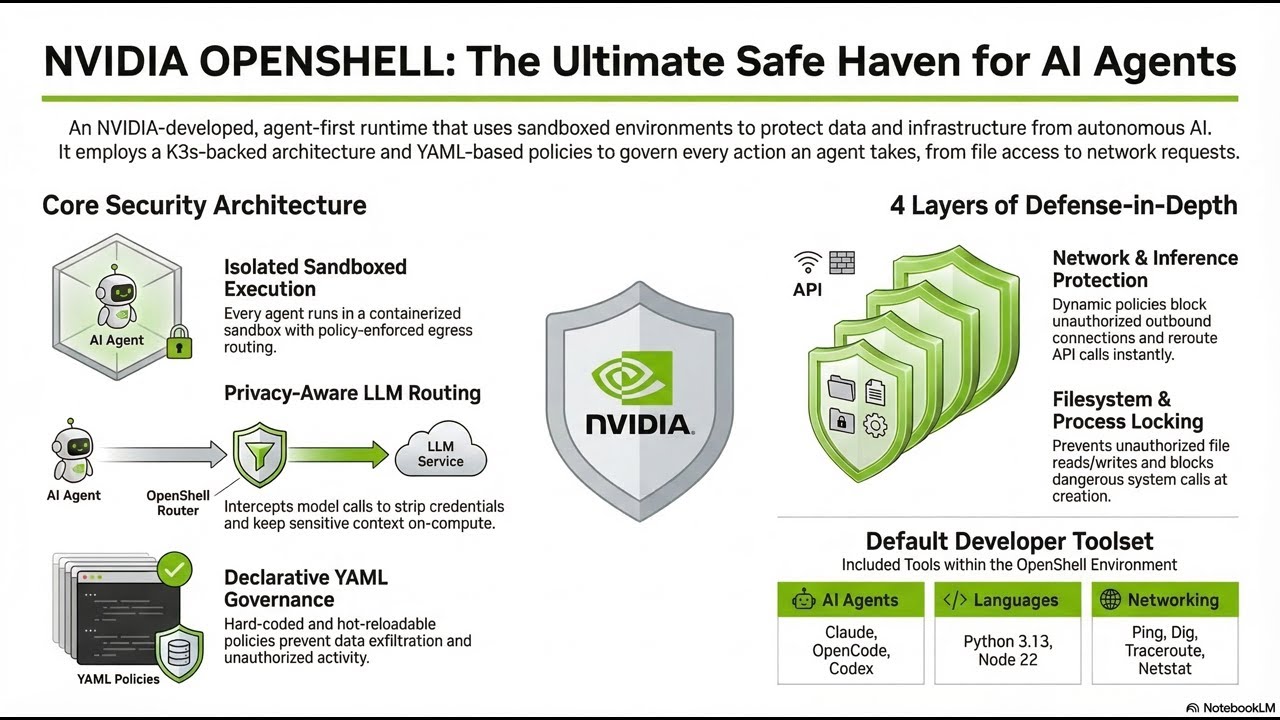
Because it separates the agent's chaotic reasoning engine from the actual execution environment, the setup makes sense. In my experience, this completely. Bound only to explicitly authorized requests, while multi-tenant isolation keeps test scripts from trampling shared assets. Bound only to explicitly authorized requests, while multi-tenant isolation keeps test scripts from trampling shared assets. And orchestrating business logic over days or weeks, having an external circuit breaker isn't just nice to have – it is baseline engineering hygiene. And orchestrating business logic over days or weeks, having an external circuit breaker isn't just nice to have – it is baseline engineering hygiene.
Watching massive enterprises like Slack and Cadence adopt — oddly — this approach tells me the industry is finally sobering up from pure hype. This we're moving past the demo phase and into the messy reality of output systems where security and guardrails actually matter. If you're building anything that gives an LLM the keys to the kingdom. Take a serious look at runtime isolation (worth noting) before your next retrospective becomes an post-mortem. Now, if you're building anything that gives an LLM the keys to the kingdom, take a serious look at runtime isolation before your next retrospective becomes an post-mortem.