GPU-Accelerated Clustering for Financial Instruments at Scale
Scaling quantitative finance pipelines requires clever engineering around memory bottlenecks. Here is how modern GPU hardware tackles massive dependence matrices....
Most portfolio risk models are built on a lie: that asset correlations stay put. They do not. When markets panic, small boundaries blur and dependencies shift aggressively, leaving rigid classification systems completely blind to hidden concentrations of risk. I suppose, if your clustering pipeline cannot separate routine noise from genuine structural breaks in real time, you're essentially driving blindfolded through a hailstorm. I have always been fascinated by how stubbornly quantitative finance clings to slow, legacy CPU workflows for problems that demand raw, parallel throughput.
Never, the core bottleneck has been raw compute alone; it is memory pressure and bad math. The old hard clustering forces every single instrument into one neat box. Destroying the graded exposures that actually matter for risk budgeting. Often, soft factorization handles these boundary instruments much better, but dense matrix goals choke the moment you try to scale past a modest universe of assets. Dense matrix goals choke the moment you try to scale past a modest universe of assets. In a way, nobody wants to wait hours for a covariance matrix to invert while the market is actively repricing itself around them.

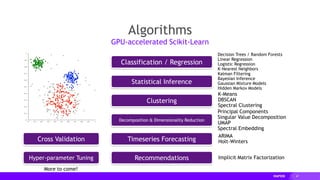
That is precisely why recent work use GPU-accelerated matrix factorization algorithms like AdaptGrow is genuinely refreshing. By dropping peak memory footprints down drastically and row-sharding massive dependence matrices across nodes, engineers can now factorize upwards of a million instruments without breaking a sweat. It is a masterclass in respecting hardware constraints. Instead of forcing developers to manually tune separate solvers for distinct input structures, a single adaptive solver reads the eigenspectrum directly, shifting between full-batch and block-stochastic gradients on the fly.
Good engineering solves real — to be fair — bottlenecks instead of hiding them behind layers of abstraction. Being able to process Pearson correlations alongside tail-dependence matrices on modern hardware changes what's possible for small quantitative shops and large desks alike. When your setup runs fast (and this is key) enough to rerun the entire pipeline as fresh returns arrive. You stop guessing about structural breaks; and, start reacting to them.