OlmoEarth v1.1 Proves That Efficiency Beats Raw Scale
Model size gets all the hype, but real engineering happens when compute costs drop by 3x without breaking benchmarks....

We need to talk about efficiency. For the past few years, the machine learning industry has been completely obsessed with brute-force scaling, pushing parameter counts into the stratosphere and pretending that throwing more hardware at a problem is a substitute for actual architectural craft.
That is why the release of OlmoEarth v1.1 caught my attention. Instead of bloating the model with more factors to chase marginal leaderboard gains, the team behind it focused on the brutal economics of spatial data inference. When you're processing satellite feeds across entire — to be fair — continents. Compute isn't just a backend detail – it's the entire bottleneck, they realized that.
The secret sauce here isn't magic. It comes down to fundamentally rethinking how transformer models ingest remote sensing data by surgically slashing token sequence lengths. Because compute costs scale quadratically with sequence length, even small optimization tweaks yield massive financial and operational dividends.
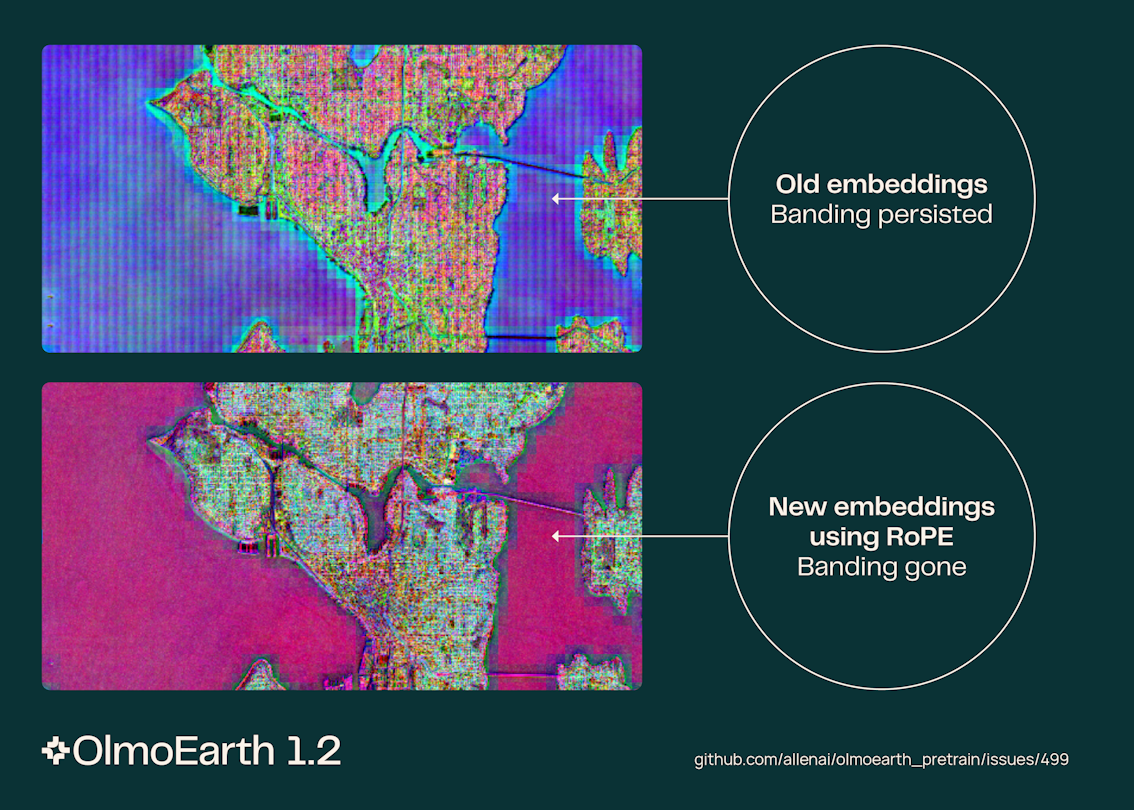
Transformer architectures are notorious hogs when dealing with multi-spectral imagery like Sentinel-2 streams. By rethinking token representation and dropping redundant spatial patches, they managed to cut compute costs by up to 3x while keeping v1's performance intact across rigorous research benchmarks.
This is the kind of practical engineering we love to see. It respects the constraints of builders who actually deploy models in the real world, proving once again that thoughtful optimization will always beat out endless hype.









