ByteDance’s Astra and the Shift Toward Autonomous Robot Navigation
ByteDance has introduced Astra, a dual-model architecture designed to solve complex indoor routing challenges for general-purpose mobile robots....
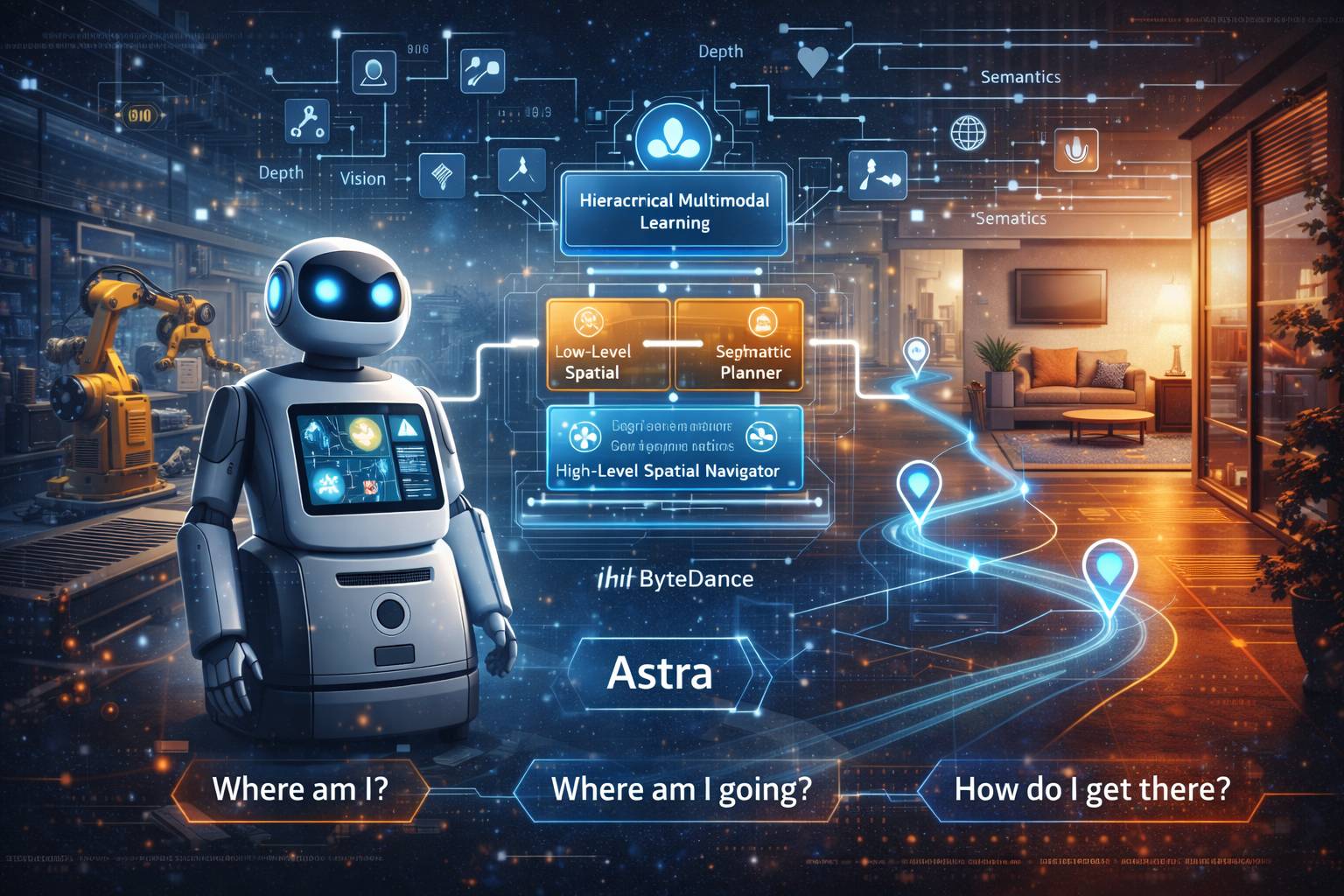
Autonomous robot navigation has long been bottlenecked by fragmented software architectures. Traditional deployments rely on a patchwork of rigid, rule-based modules to handle separate chores like target identification, global positioning, and immediate obstacle avoidance. In repetitive environments such as industrial warehouses, these systems frequently break down, forcing operators to install artificial markers like QR codes just to keep mobile units on track. As robotics moves past tightly controlled factory floors into unpredictable indoor spaces, this reliance on brittle heuristics has become unsustainable.
Attempting to bridge this gap, researchers at ByteDance have unveiled Astra, a hierarchical multimodal framework detailed in their recent paper, 'Astra: Toward General-Purpose Mobile Robots via Hierarchical Multimodal Learning.' Inspired by the psychological distinction between fast, instinctive responses and slow, deliberate reasoning, Astra splits navigation duties into a two-tiered system. The architecture pairs a high-level cognitive core with a rapid execution loop, attempting to streamline how mobile hardware interprets complex spatial surroundings.
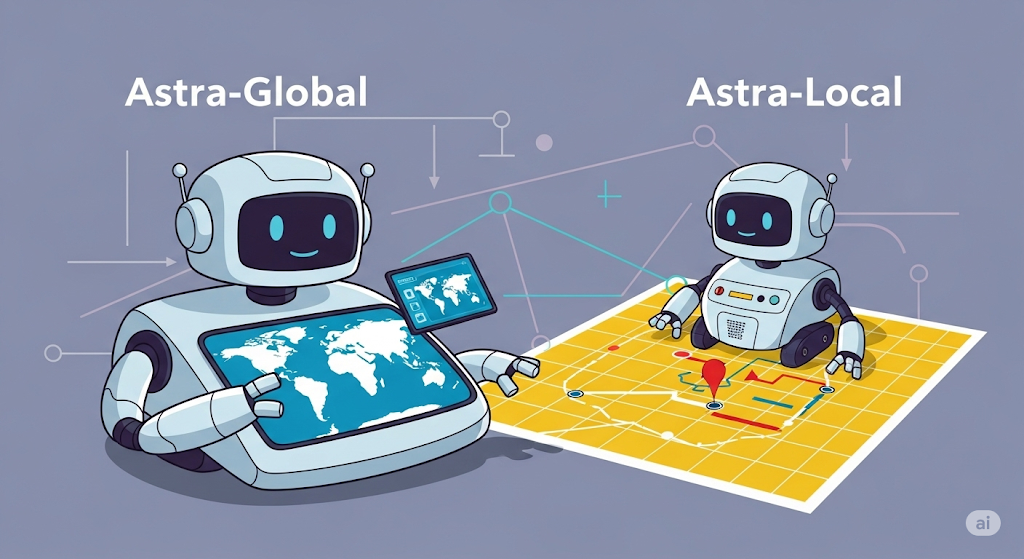
The framework divides labor between two distinct sub-models: Astra-Global and Astra-Local. Operating on a low-frequency schedule, Astra-Global functions as a Multimodal Large Language Model capable of processing both visual and linguistic cues. It anchors the robot within a hybrid topological-semantic graph, allowing the machine to understand text instructions or visual queries and pinpoint its exact coordinates on a map. Meanwhile, Astra-Local handles the high-frequency demands of real-time movement, managing immediate path planning and odometry estimation to bypass unexpected obstacles safely.
Structuring robotics software around dual-model pipelines points toward a broader industry maturation, moving away from monolithic networks toward modular specialization. Building robust systems that bridge high-level reasoning with physical execution requires deep architectural discipline, an engineering challenge our team at Xetarev Studio navigates daily when helping clients build complex software products.









