Why GPT-Live-1 Finally Fixes the Nightmare of Real-Time Voice AI
For years, building conversational voice apps meant stitching together clunky speech-to-text and text-to-speech pipelines. OpenAI's GPT-Live-1 API finally cuts out the middleware....

If you have ever tried building a real-time voice assistant, you know the quiet despair of the cobbled-together pipeline. For years, the standard recipe has been an unholy trinity: take a speech-to-text model, pass its output to a reasoning LLM, and then pipe that text into a text-to-speech generator. It is brittle. It is slow. Every single handoff introduces annoying latency, turning what should be a snappy conversation into an awkward game of digital walkie-talkie where users constantly talk over the system because the timing is off by half a second.
OpenAI just dropped the GPT-Live-1 API, and for once, the reality might actually match the marketing deck. Finally, by handling incoming and outgoing audio through a single unified model, they are ditching those painful, multi-step chains. The architectural win here is massive. Instead of waiting for a sentence to finish before generating audio, the system listens and speaks concurrently. It can process subtle interruptions, awkward hesitations, and noisy background environments without completely losing its place or narrating every internal thought out loud to the user.
What gets me most excited as a builder isn't just the snappy audio handling, though. It is the architectural separation of concerns. You get a frontend model that actually understands human cadence, prompt-steered tone, and telephony support, while the heavy lifting of deep reasoning and tool execution gets cleanly delegated to a backend model. It is a sensible split.
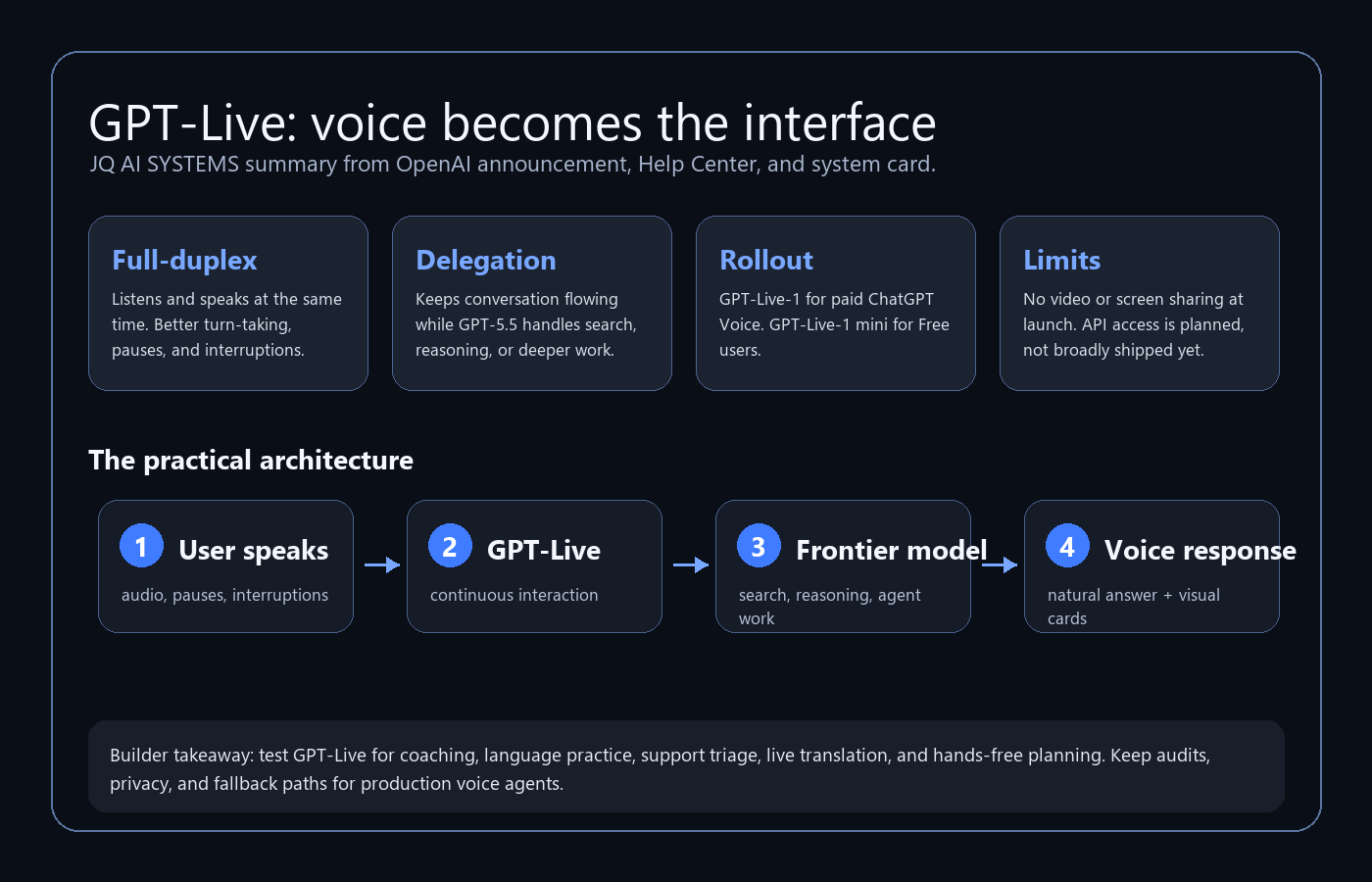
Low-level, of course, relying on an end-to-end proprietary audio model means you trade away a bit of control for incredible developer velocity. You are trusting their black box to manage the subtle of human speech. Simply, but when you look at early tests – like language learning apps cutting accidental interruptions by nearly eighty percent because the model knows how to pause and listen – it is hard to argue with the UX results.
The era of the clunky, stuttering voice bot is officially on borrowed time. The if we're going to build software — oddly — that talks to people all day, – no, wait, it better keep up with how we actually speak. This update moves us past the duct-tape phase of voice interfaces. Here's the deal: also, into something that — no, wait, finally feels genuinely human.









