Shrinking Nemotron 3.5 Lightning NVFP4: Why Quantization-Aware Distillation Matters
Aggressive model quantization usually breaks things. Here is how quantization-aware distillation keeps fast, tiny LLMs accurate....
We all want faster local inference. Nobody wants to sacrifice accuracy to get it. When NVIDIA dropped the Nemotron 3.5 Lightning NVFP4 checkpoint, it caught my attention because it actually addresses the memory wall head-on. Dropping a hefty 66 GB full-precision model down to a lean 22 GB footprint is no small feat. But is it really that simple? That's the kind of practical engineering win that makes local deployment genuinely viable for smaller teams who cannot afford dedicated clusters of enterprise hardware. That is the kind of practical engineering win that makes local deployment genuinely viable for smaller teams who cannot afford dedicated clusters of enterprise hardware.
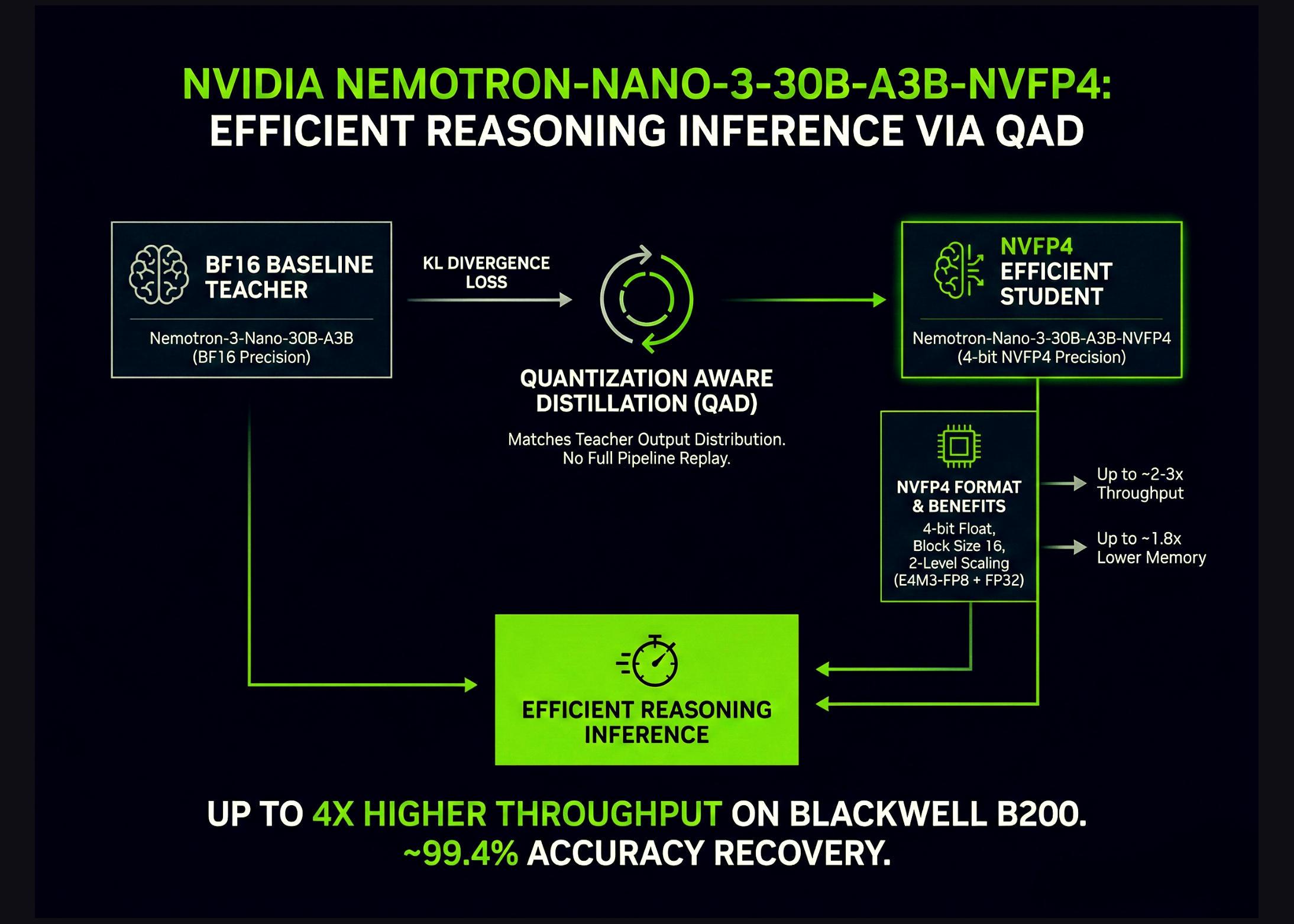
Standard post-training quantization gets you part of the way there. Push it too far, though, and your model starts hallucinating nonsense because the weights get butchered. To combat this degradation, NVIDIA leans on quantization-aware distillation, or QAD. Instead of just compressing and praying for the best, QAD uses the original uncompressed model as a strict teacher guiding a smaller, aggressive student model through simulated quantization noise.

The two-stage pipeline is elegantly brutal. First, you run a rough PTQ pass to slash weights down aggressively, squeezing out maximum throughput even if it introduces some initial accuracy rot. Then, stage two kicks in with distillation, aligning the student's logits with the frozen teacher via KL divergence loss. This recovers nearly all the lost capability without bloating the runtime footprint back up.
It is a stark reminder that raw model size is often a vanity metric. If smaller, heavily quantized weights paired with clever distillation can match baseline benchmarks on complex agentic tasks, then massive full-precision models are starting to look obsolete. For builders shipping real software, this is the exact kind of systems-level tuning we need more of.