Why Google’s Co-Scientist Actually Matters for the Future of Research
Google DeepMind's new multi-agent system tries to solve the real bottleneck in science: not running experiments, but dreaming up the right hypotheses....

Most tech coverage obsesses over how fast a machine can crunch data or synthesize a protein. But the real bottleneck in modern science isn't computation. It is imagination. Researchers drown in an ocean of fragmented papers, endless datasets, and suffocating administrative noise, leaving precious little cognitive bandwidth to connect disparate facts and formulate genuinely novel ideas to test. That is the actual problem Google DeepMind is trying to solve with their new multi-agent AI system, Co-Scientist.
Instead of treating a language model like a glorified search engine or a single oracle, this architecture mimics the messy, adversarial nature of actual scientific progress. It breaks the workflow into specialized roles – generation agents that brainstorm wildly across literature, reflection agents that act as vicious virtual peer reviewers, and ranking loops that pit competing theories against one another in simulated debates. It is structured friction. It forces ideas to survive a gauntlet before a human ever steps into a wet lab.
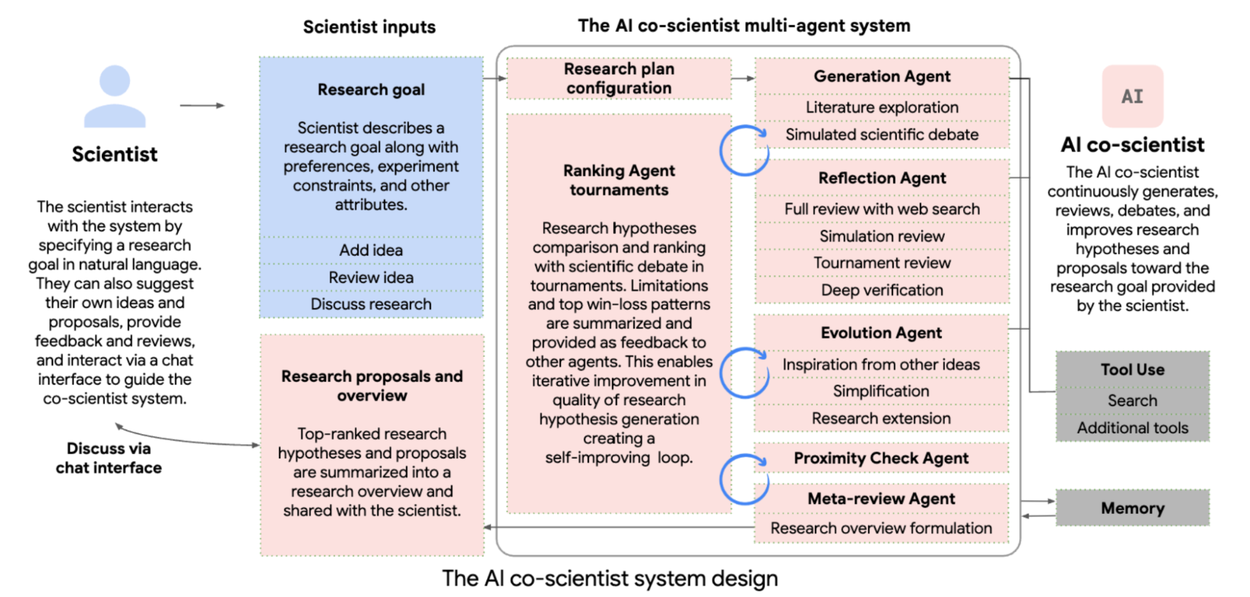
Because science is messy, stubborn! It I'm naturally skeptical of big lab announcements that promise to revolutionize complex human effort overnight, mostly. Makes sense, right? Deeply resistant to silver bullets. Basically, yet, building tools that aggressively — oddly — challenge our assumptions rather than just confirming them feels like the right path forward. When you give small teams or solo researchers an automated sparring partner that can map out an unexplored conceptual scene in minutes, the use is staggering.
We are stepping away from an era where generative AI is merely used to polish prose or write boilerplate code. If systems like this prove strong in the wild, honestly, also, beyond. It they'll deeply shift what — surprisingly — a small. Focused group of builders can accomplish — or more precisely, in life sciences. Just, the future belongs to those who ask better questions, not those who execute faster.