Dense vs. MoE Models: Cutting Through the Architectural Hype
Forget raw parameter counts. Choosing between dense models and mixtures-of-experts is about hardware reality, memory bandwidth, and deployment constraints....

Everybody loves a bigger parameter count. It makes for great headlines, easy venture capital pitches, and lazy benchmarks. But if you are actually building software that relies on modern AI infrastructure, raw numbers lie. What actually matters is how those parameters are organized, how they load into VRAM, and what happens to your latency when a user hits send. That brings us to the eternal tug-of-war between dense models and Mixture-of-Experts architectures.
Think of a dense model as a heavy-duty V8 engine where every single cylinder fires on every single stroke, regardless of whether you are crawling in city traffic or tearing down a highway. Every parameter participates in every forward pass. It is predictable, straightforward to deploy, and brutally honest about its memory footprint. But it is also inherently wasteful. You pay the performance tax for the entire network on every single token, even when the input is just a simple greeting.
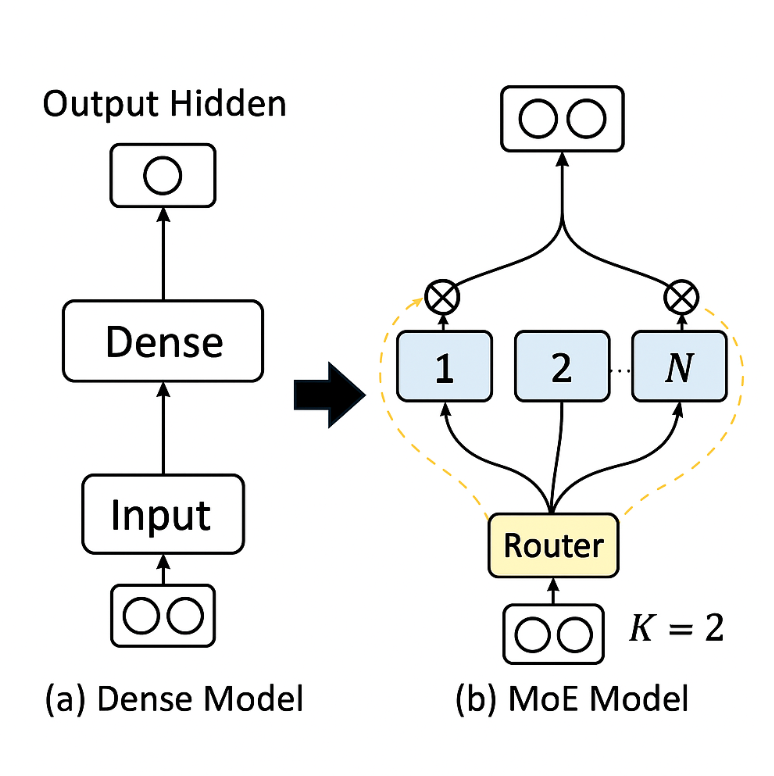
MoE models flip the script by introducing a router that dynamically selects a tiny subset of experts for each token at every single layer. [IMAGE]
Suddenly, a massive 30-billion parameter model only activates a fraction of its capacity per token, delivering the intellectual breadth of a giant with the speed and agility of a much smaller network. Yet this clever trick comes with a catch. The routing overhead, memory bandwidth bottlenecks, and serving complexity can turn a production deployment into an absolute nightmare if your hardware isn't tuned for it.
Ultimately, picking between these two model isn't about chasing the latest measure crown or swallowing promo spin from labs pushing hyper-specialized setups. It comes down to your operational reality. If you have the memory bandwidth and want maximum throughput for heavy workloads, MoEs are brilliant. Predictable serving without orchestration headaches, keep it dense if you need rock-solid.