Content transparency is finally moving from vaporware to infrastructure
Google is expanding SynthID and C2PA standards across search and devices, turning AI content verification into actual plumbing....

For years, the debate around generative media felt entirely paralyzed by hand-wringing. Everyone agreed we needed content transparency, yet nobody built anything that actually worked at scale. We watched endless demos of detectors with abysmal false-positive rates, while pristine family photos and deeply flawed deepfakes alike swirled into the same opaque algorithmic feed. It was exhausting. The tech industry loves inventing a problem, panicking about it for eighteen months, and then selling you a half-baked SaaS product to fix the mess they just created.
Now, the approach is shifting from clumsy retroactive guessing to actual plumbing. Google is pushing its SynthID watermarking tech deeper into consumer hardware, embedding metadata straight at the sensor level in Pixel cameras and weaving C2PA standards across search, browsers, and mobile apps. When provenance happens at the moment of capture, the entire model changes. You stop asking a brittle AI model to guess if an image is real after the fact. Instead, you look at cryptographic proof that says whether a sensor actually captured photons or a model generated pixels out of thin air.
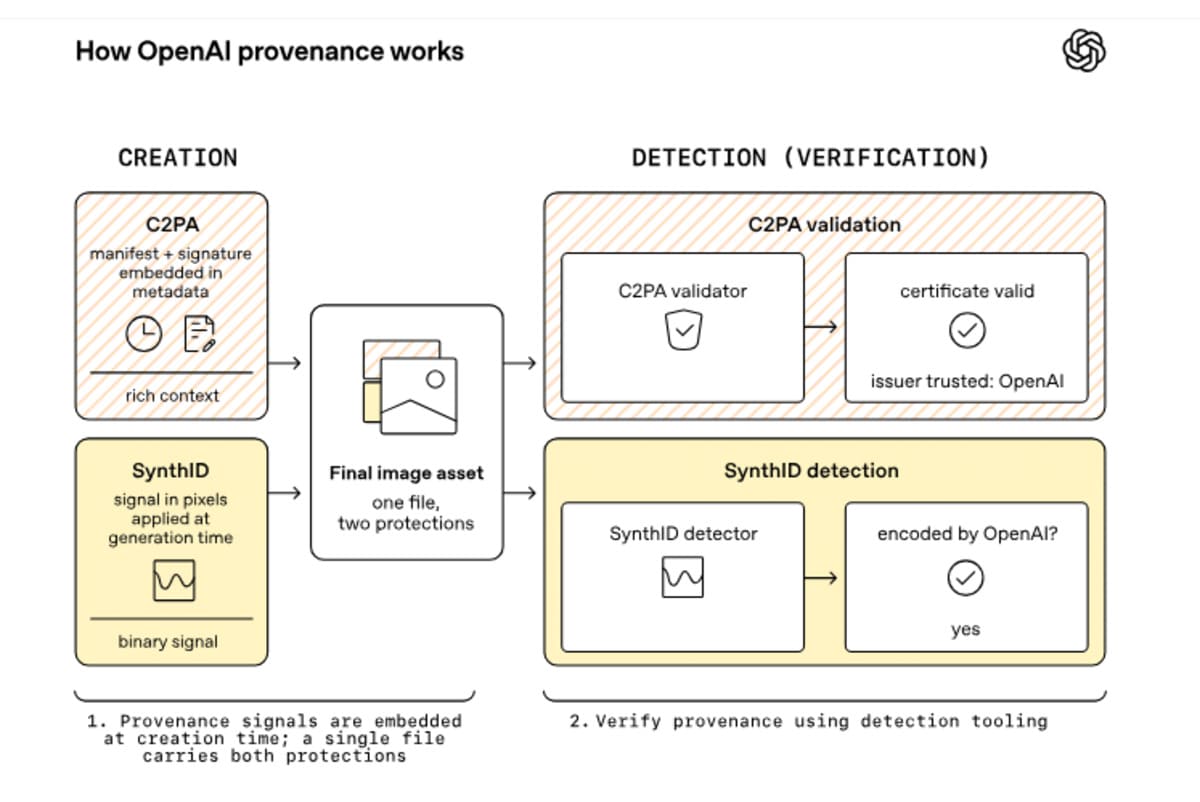
This hardware-level integration matters immensely. Think about how digital media actually travels. It gets compressed, screenshotted, uploaded to messaging apps, re-compressed, and posted to public timelines where context completely evaporates. If a watermark or metadata tag vanishes the second a JPEG is compressed, it's useless. By combining invisible, noise-resilient signals with open industry standards that major players like OpenAI and ElevenLabs are starting to adopt, we might finally achieve interoperable truth across the web.
Of course, metadata isn't a silver bullet. Bad actors will strip it, spoof it, or find novel ways to bypass capture-level logging entirely. But raising the friction for deception is a massive win for everyone who builds on the web. We don't need absolute perfection to make digital spaces slightly more honest. Just, we need the baseline tools for content verification to be so ubiquitous that pretending an AI hallucination is a breaking news photograph becomes too annoying to bother with.









