PaddleOCR 3.5 Brings Transformers Support to Document Parsing
PaddleOCR 3.5 drops with native Transformers backend support, making document parsing pipelines a whole lot cleaner for builders....

If you have ever tried building a serious RAG pipeline or a document-processing agent, you already know the dirty secret of modern AI engineering. The LLM is rarely the bottleneck. The real pain lives upstream, hidden away in the messy reality of scanned PDFs, crooked screenshots, weird tables, and mangled mathematical formulas that refuse to parse cleanly into structured text.
Get that ingestion layer wrong — and your downstream retrieval system turns into a guessing game. Feeding your expensive models garbage context. While you wonder why your answers look like hallucinated poetry. That's why I always pay close attention whenever strong vision-language models and OCR engines get updates. They quietly do the heavy lifting that makes intelligent document automation actually work in output.
With the release of PaddleOCR 3.5, the ecosystem just got a bit more frictionless! Here's the deal: this while they're keeping their heavy-hitting models like PP-OCRv5 and PaddleOCR-VL 1.5 intact. Makes sense, right? The big architectural shift here is a modular inference interface. You can now swap out the backend engine simply by declaring a parameter. Routing your calls directly through the Hugging Face ecosystem instead of wrestling with proprietary stacks. Realistically, not quite.
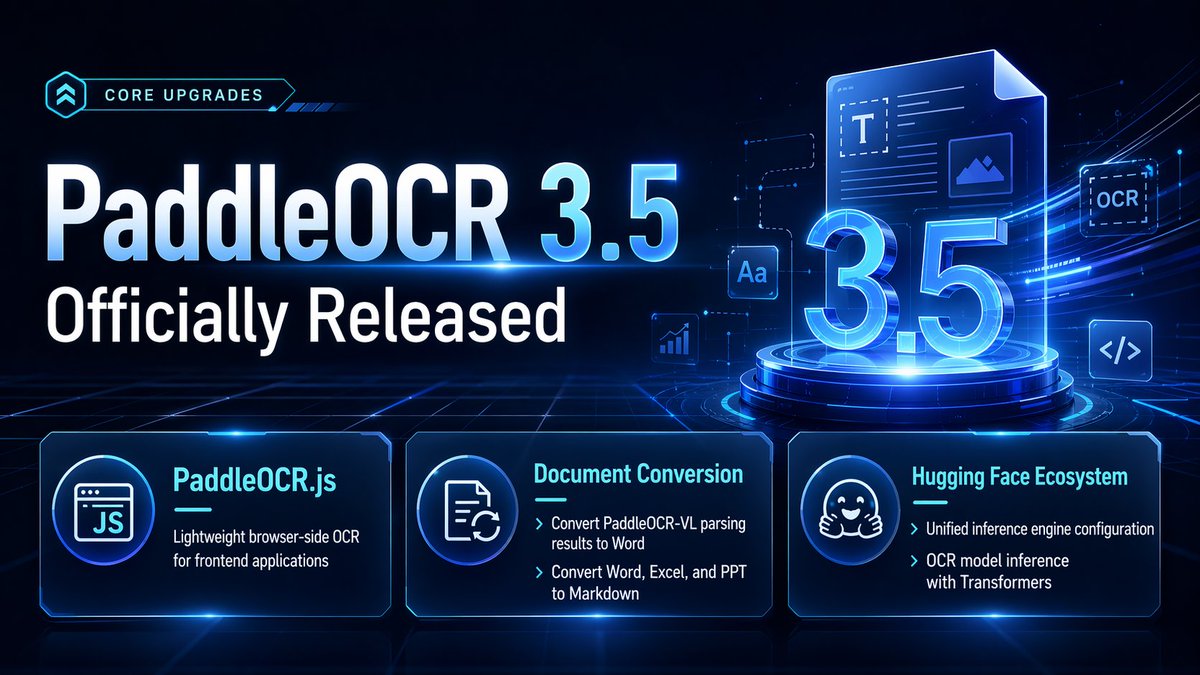
For developers knee-deep in PyTorch and standard Hugging Face tooling. This means fewer custom wrapper headaches and device placement headaches. The you can dial in your data types, target your hardware cleanly. It's a pragmatic win for builders who prefer clean code over juggling fragmented dependencies just to extract text from an firm invoice. Just, it's a pragmatic win for builders who prefer clean code over juggling fragmented dependencies to extract text from an enterprise invoice.
practical engineering wins over hype. Simplifying the path from a messy PDF to clean structured data means we can spend less time fighting plumbing and more time building software that actually solves real problems.









