DiScoFormer Solves the Density-Versus-Score Trade-Off in Machine Learning
Meet DiScoFormer, a single transformer architecture that tackles both density estimation and score-matching across distributions without requiring retraining....

Most of machine learning quietly boils down to a single obsession: figuring out where data likes to hide. If you have a scattered cloud of points, your job is to reverse-engineer the invisible field they emerged from. You need to know what is common and what is rare. Traditionally, this meant wrestling with two stubborn quantities: the density, which acts like a smooth multidimensional histogram, and the score, which is just the gradient of the log-density telling you precisely which direction to push a point to make it more probable. For years, practitioners had to choose their poison when dealing with these metrics.
The tooling has always forced an annoying trade-off. On one side, classical methods like kernel density estimation require zero training and adapt to almost anything, but they completely fall apart the moment your dimensionality starts creeping up. On the other side, modern neural score-matching models thrive in high dimensions, yet they demand a complete retraining session from scratch every single time your underlying distribution shifts. It is clumsy. It wastes compute. It feels like a hack rather than a fundamental solution.
Enter the DiScoFormer. This is a transformer designed to map an entire dataset straight to its density and score in one clean forward pass, entirely bypassing the need for endless retraining cycles. By building a shared backbone with dual output heads, the architecture use the inherent mathematical marriage between density and score. The score head literally has to match the gradient of the log-density head at any given query point, creating a brilliant built-in consistency check.
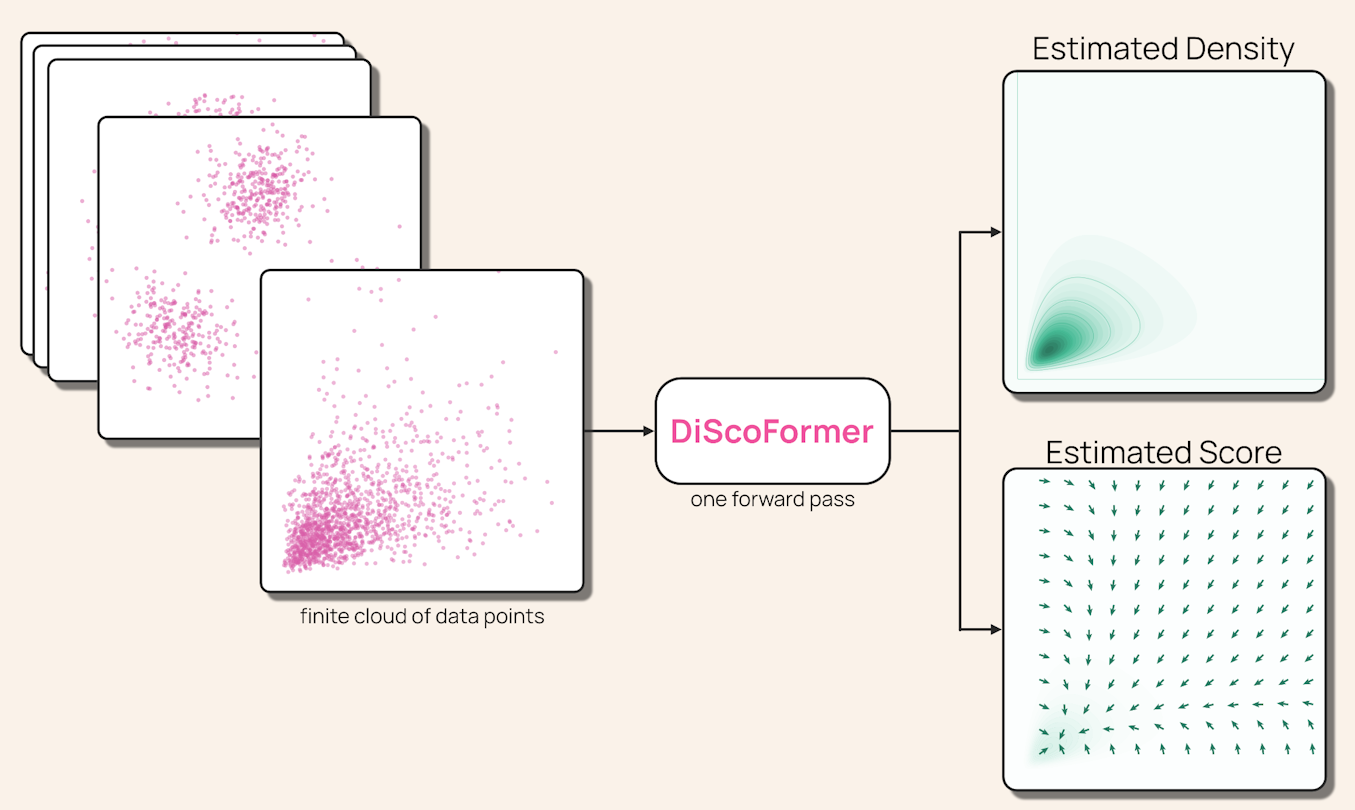
What excites me most here isn't just the parameter efficiency or the clever cross-attention trick that lets it evaluate any arbitrary point in space. It is the inference-time adaptation. Because that consistency loss exists without needing ground-truth labels, the model can actually tweak itself on the fly when fed out-of-distribution inputs. It adapts locally, on the spot, using zero ground truth. That is the kind of elegant engineering that makes you sit up and pay attention. Hype fades, but solid mathematical foundations last.
If you think about it, natively, we're watching a shift away from brittle, single-purpose pipelines toward models that understand geometry. They need underlying tools don't shatter the second data changes shape, if diffusion models and Bayesian samplers are going to get any smarter — or so it seems. Directly, diScoFormer points toward — oddly — that future, and I'm here for it.









