Fixing the Trillion-Parameter Bottleneck with Delta Weight Sync
Async RL training has a dirty data-shipping secret, but delta weight sync changes the math entirely....
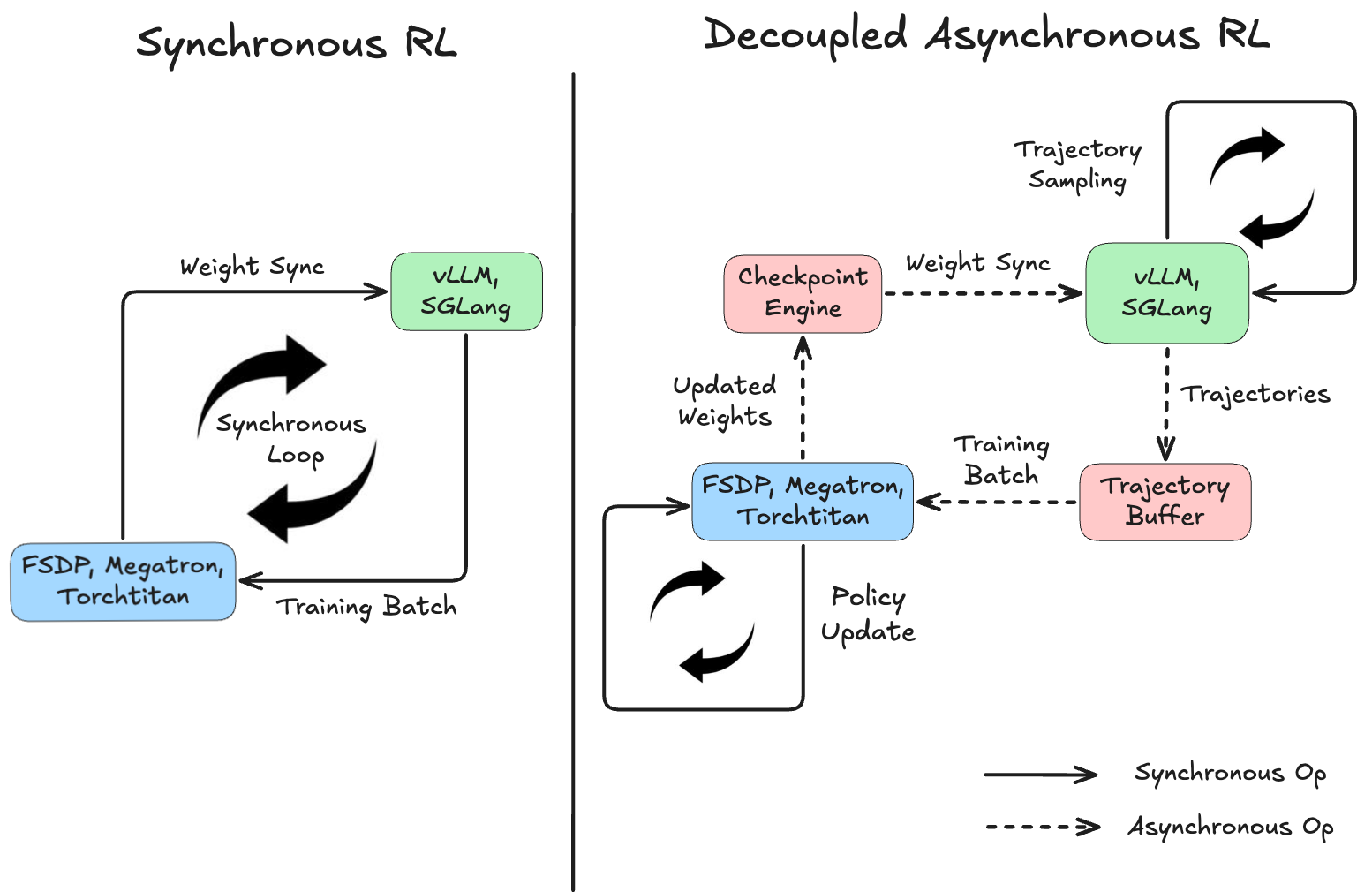
Let's talk about the dirty secret of asynchronous reinforcement learning. Every single step, your trainer needs to ship the entire model over to the inference engine. For a modest seven-billion parameter model in bf16, that is fourteen gigabytes. Scale that up to a frontier one-trillion parameter beast, and you are staring down the barrel of roughly a terabyte of data moving across the wire every single step. It is absurd. It eats bandwidth, wastes expensive GPU cycles on idle waiting, and drives infrastructure costs straight through the roof.
For years, standard industry practice demanded treating every single checkpoint update like a total ground-up replacement. We threw more hardware at the problem. We built complex mega-clusters, tangled up RDMA fabrics, and set up dedicated cross-region links just to brute-force a terabyte file back and forth. Completely, but it turns out we were doing it wrong. When you look closely at two consecutive RL optimizer steps, roughly ninety-nine percent of the weights are actually bit-identical. The real mutation between steps is microscopic.
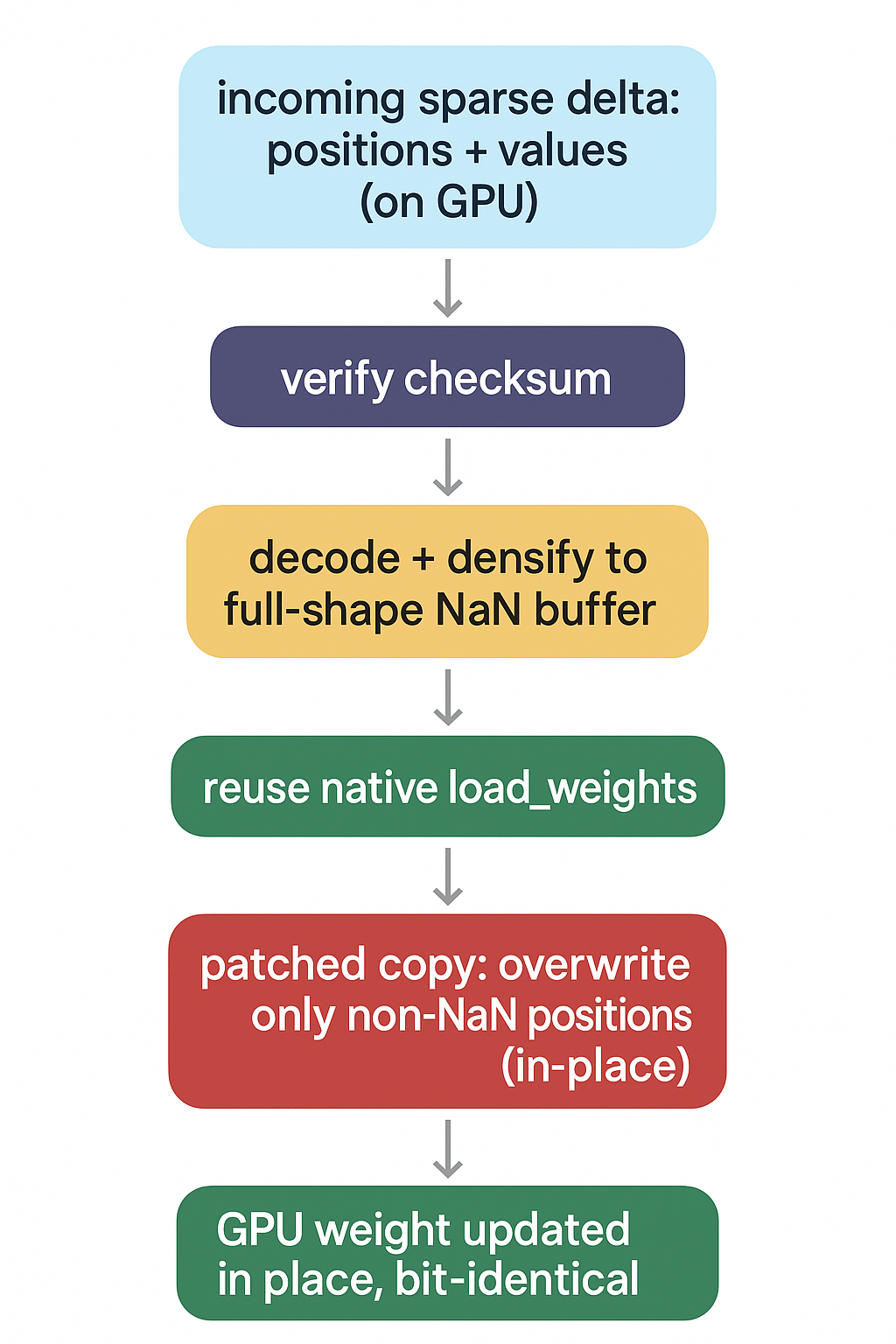
Recently, the folks working on TRL landed a brilliant PR that fixes this waste by encoding only the mutated elements into a sparse safetensors file, pushing that tiny diff to a Hugging Face Bucket, and letting vLLM pull just the changes. The payload shrinkage is staggering. On a Qwen model, the per-step data transfer plummeted from over a gigabyte down to a few dozen megabytes. That isn't an incremental optimization. That is a fundamental model shift for how small teams can manage heavy inference pipelines without needing a venture-capital-sized cloud budget.
Even better, this unlocks truly disconnected, modular training setups. You can run your trainer on one box, drop your inference engine into a remote space, and let the weights flow gracefully through a simple shared bucket without any shared clusters or VPN nightmares. Good engineering isn't always about buying faster interconnects or throwing more compute at a bottleneck. Sometimes, it is just about realizing you only need to ship the data that actually changed.









