Pruning LLMs Like a Physicist: Why Physics Solves LLM Compression
Most LLM compression treats transformer layers like independent units. By framing block removal as an Ising spin glass, researchers just unlocked a massive leap in deep compression....
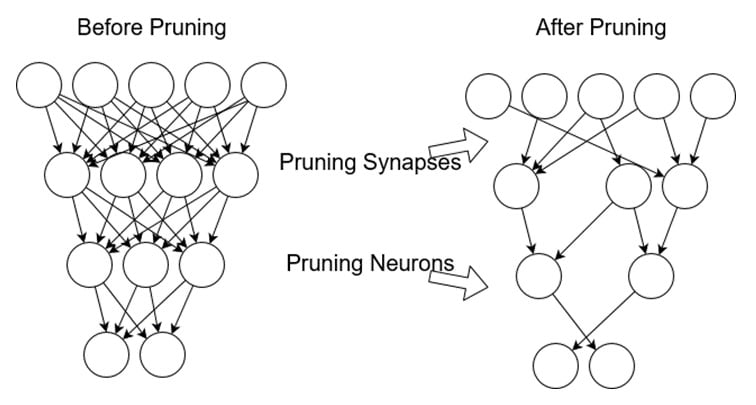
Most of the machine learning world treats model pruning like a ruthless corporate layoff. You evaluate every transformer block in isolation, hand out performance reviews based on magnitude or sensitivity, and fire the bottom ten percent. It feels efficient. It is also fundamentally flawed, because deep neural networks are not collections of independent workers operating in silos; they are tightly coupled ecosystems where removing one component completely destabilizes the behavior of its neighbors. We keep trying to solve complex combinatorial nightmares with blunt, mean-field heuristics that assume linear independence where none exists, leaving massive amounts of performance on the table simply because we refuse to look at the underlying mathematics.
A fascinating new paper flips this lazy — and this matters — framework on its head by approaching LLM compression through the lens of statistical physics. The researchers mapped block selection directly onto an Ising glass – a disordered magnetic spin system packed with all-to-all interactions. From what I can tell it Instead of treating layers as standalone entities! But not only. It makes sense, right? So basically, by attaching a binary variable to every single transformer block, representing whether it stays or goes. They managed to capture — and this matters — the exact pairwise couplings that standard pruning methods completely ignore. Suddenly, deciding which blocks to prune transforms from a guessing game into a classical energy-minimization problem. Letting a second-order Taylor expansion do the heavy lifting by mapping out — well how these layers actually influence one another.

The payoff is genuinely staggering, mainly when you push models into aggressive, deep-compression regimes where standard heuristics usually fall flat on their face. The when cutting fifty percent of the layers out of Llama-3.3-70B-Instruct. But this physics-inspired approach secures nearly a twenty-three percentage point gain on MMLU compared to the best competing block-removal strategies out there. That's not a marginal boosting tweak or a rounding error. When you stop fighting the math of a system and finally decide to respect it, forward, that is the kind of massive, real leap that happens only.
We need more of this cross-disciplinary thinking in tech, less cargo-culting! It a lot more genuine engineering craft—at least for now. But is it really that simple? But too many teams throw brute force. And endless compute at structural problems that require elegance instead of brute muscle. Sort of, when you borrow tools from statistical mechanics to solve software bottlenecks, you remember why foundational science still matters. Just, it turns out that viewing how disordered spin — oddly. Systems behave might be the secret weapon we need to make massive language models actually fit on our hardware.