When Encode-Prefill-Decode Disaggregation Actually Matters for Multimodal Serving
Split your vision encoders from your LLM pipeline, but only if your workload justifies the engineering overhead. Here is what the benchmarks miss....
Most serving architectures were built for pure text. Then multimodal models arrived, crashing the party with heavy image and video encoders that completely wreck standard scheduling loops. When a single request forces your GPU to chew through gigabytes of visual tokens before the LLM can even touch a prefill phase, everything grinds to a halt. Text-only traffic starves in the queue. Latency spikes. It is a mess.
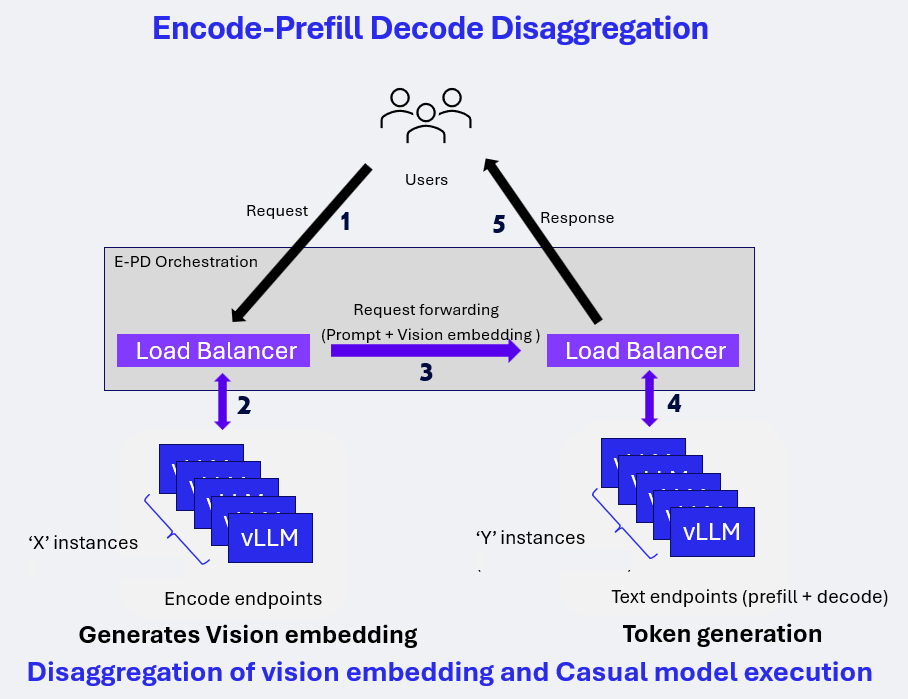
Enter encode-prefill-decode (EPD) disaggregation. The pitch sounds brilliant: decouple the vision encoder from the prefill and decode workers so they scale independently. If you are pushing heavy image prompts through quantized mixture-of-experts models, frameworks like NVIDIA Dynamo promise massive speedups – up to five times faster time to first token and seven times better end-to-end response times. That is the kind of leap that makes infrastructure engineers sit up straight.
But let us be realistic about the trade-offs. Moving embeddings across workers introduces network and coordination overhead that can easily eat your lunch if your vision payload is too small. If your prompts are mostly text with a tiny thumbnail attached, disaggregation is an expensive engineering vanity project. You are just adding distributed complexity for zero real gain. Context matters.

When you do have image-heavy workloads, placement is everything. You can colocate your encoders or isolate them on separate hardware tiers, but you have to measure the bottleneck before touching the topology. Good architecture isn't about blindly chasing benchmark multipliers published by hardware vendors. It is about matching the pipeline shape to the actual traffic hitting your servers.
Stop treating infrastructure patterns like silver bullets. Disaggregate your inference stack if your vision encoders are genuinely choking your LLM throughput. Otherwise, keep it simple, keep it tightly coupled, and save the distributed plumbing for when you actually scale.