NVIDIA Kumo Tabular Changes How We Look at Spreadsheet Data
Forget endless hyperparameter tuning and manual feature engineering. A new foundation model is finally bringing zero-shot learning to raw tabular data....
If you've ever spent an entire week scrubbing messy CSVs just to squeeze two extra percentage points out of a stubborn XGBoost model. I feel your pain deeply. For decades, tabular prediction has remained an exhausting, mechanical ritual of missing-value imputation. Which brute-force hyperparameter sweeps that feels far more like low-wage data janitorial work than actual engineering.
While the rest of the machine learning world rapidly shifted toward massive pretraining architectures, our messy production databases stayed stubbornly trapped in the dark ages of learning everything completely from scratch. Why do we keep accepting this tedious friction? Nvidia just dropped Kumo Tabular, an open base model family built to handle standard classification without requiring a single epoch of fine-tuning.

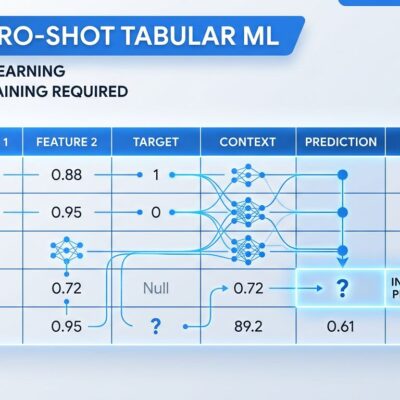
Drop in a labeled reference table, hand it the new rows you need evaluated, and watch it spit out predictions in one clean forward pass using pure in-context learning – which is trained entirely on synthetic data, spans sizes from 28M to 215M factors, and quietly dominates benchmarks right out of the box. What fascinates me most isn't merely the benchmark dominance, but rather the complete, glorious elimination of the training loop for everyday deployment scenarios.
Under the hood, it uses specialized cell embeddings – treating numerical and categorical inputs through Fourier features without forcing you to manually impute missing gaps. While applying multi-layered attention across rows, columns, and variable context windows. We should remain cautiously skeptical of any shiny new drop until it survives the brutal reality of output workloads. But this actually feels like a genuine inflection point for how small teams and solo builders will handle predictive analytics moving forward.