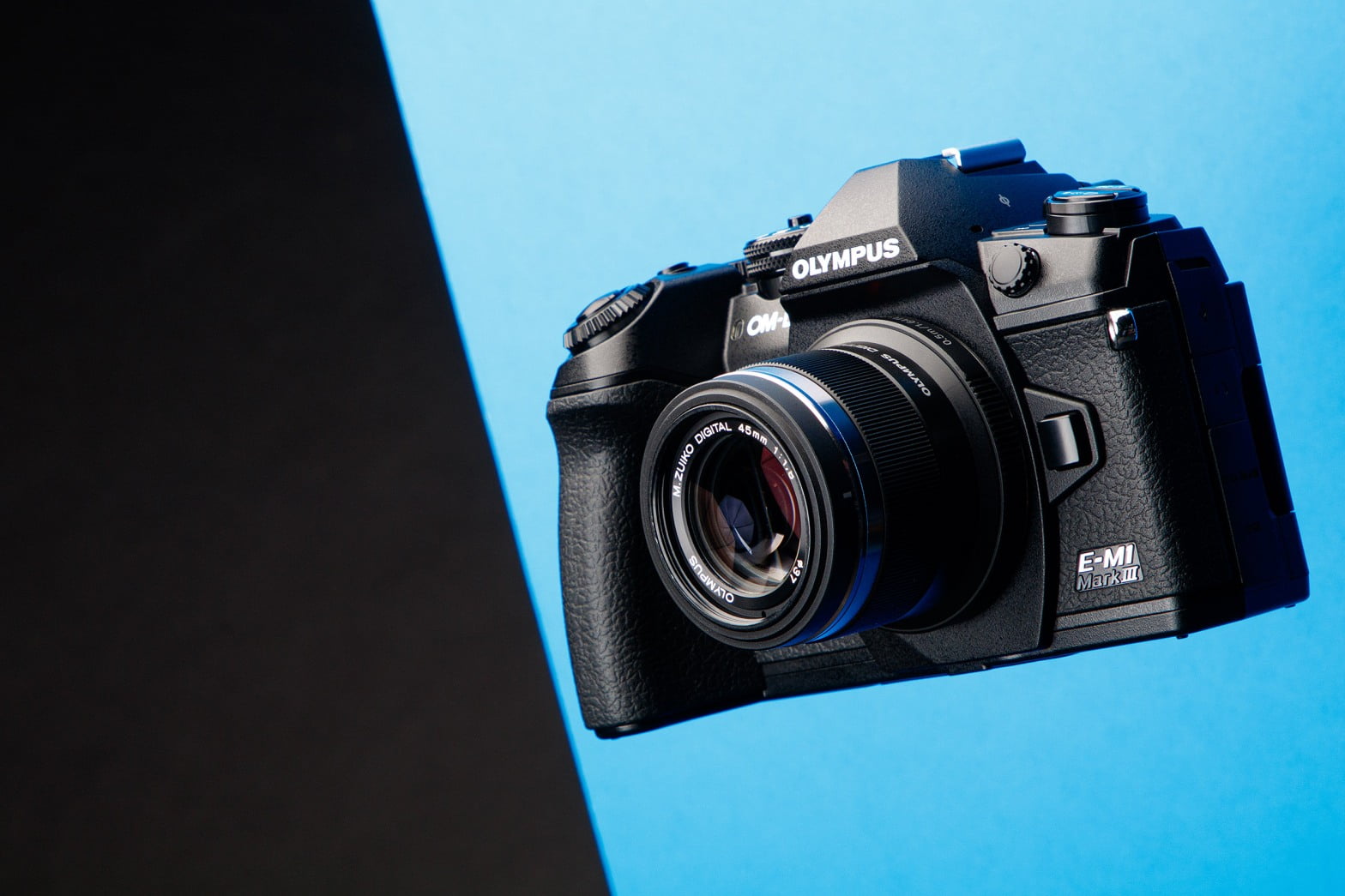

Some Key Specifications:
- 20MP Four Thirds sensor
- 121-point autofocus system with deep learning-based subject recognition
- Handheld high-res shot mode
- Up to 60 fps Raw + JPEG capture (up to 18 fps with autofocus)
- Pro Capture mode records frames before you hit the shutter
- Image stabilization rated at 7.0 (CIPA standard), up to 7.5EV with ‘Sync IS’ lenses
- ‘Live ND’ multi-shot mode simulates ND filters
- Large 2.36M-dot LCD viewfinder able to work at up to 120 fps
- 420 shots per charge (CIPA) battery life rating
- Dual SD card slots (1x UHS-I, 1x UHS-II)
- Extensive direct control, AF joystick, articulating touchscreen
- UHD 4K/30p video and DCI 24p at up to 237Mbps
- Extensive, IPX1-rated weather sealing
- USB charging (using USB PD standard)
The Olympus OM-D E-M1 Mark III is the third iteration of the company’s sports and action-oriented Micro Four Thirds model. It uses a 20MP Four Thirds sensor. Olympus says the Mark III is designed with portability and agile shooting prioritized over the better handling and operability of the larger ‘X’ model. the E-M1 III has the latest TruePic IX processor.

There’s stuff like Weather-sealed body, rated to IPX1 which is pretty good for normal rain circumstances, Extensive customizable direct controls which could be really useful for you if you like all options available on the click of a button and it also helps you to truly make it your own device, With an Easy to operate despite compact body size, you’ll love the handling and could be useful to grip too.
The E-M1 III uses the same hefty BLH-1 battery as its predecessor. It offers 12.7 Wh of capacity, which underpins a respectable rating 420 shots per charge.

With the 20MP sensor, it outputs good Raws, on par with the best Four Thirds sensors, it has Lovely JPEG color rendering, JPEGs display intelligent noise reduction but sharpening is aggressive and a bit clumsy (at default settings), ‘High Res Shot’ modes offer both a resolution and a noise benefit, Neither tripod nor hand-held ‘High Res Shot’ modes handle motion particularly well, though results from the former look a little more natural.
There’s a lot of neat features like the Continuous AF which can be tuned to be pretty effective if you can keep your camera pointed at your subject, Face and eye detect work well and it’s easy to jump between subjects using the AF joystick which is really useful for starters, Subject Tracking AF tends to be poor at following its target but increasing C-AF sensitivity may improve hit rate for some subjects, Fn lever allows for quick changing between AF modes and areas, but does not remember face / eye detection or focus limiter settings which is kind of a bummer but it does work, and works like a charm.

The E-M1 III offers a fairly compelling video package. DCI ‘Cinema’ 4K/24p footage is plenty-detailed. The E-M1 III can also shoot UHD 4K footage at 30, 25 and 24p (up to 102Mbps) and full HD capture at 60 and 50p (up to 50Mbps) as well as at 30, 25 and 24p (up to 202Mbps). For slow-motion work there’s a 1080/120p mode that can be output at 60 and 50p footage (up to 50Mbps) or 20, 25 and 24p footage (up to 26Mbps).
The body of the E-M1 III offers 3.5mm microphone and headphone ports that annoyingly get in the way of the articulating screen when in use. The camera’s touch display is highly responsive and touch-to-focus/track works with good reliability as long as the scene is not too busy or subject too small. Face detect also works well during video capture and can be especially handy for maintaining focus while vlogging.

Good Stuff:
- Good JPEG and Raw image quality
- Pleasing colors out-of-camera
- 10 fps (mechanical) and 18 fps (e-shutter) bursts with AF
- Good buffer depth
- Well-designed body is comfortable, attractive and highly customizable
- Reasonable-quality 4K video with low rolling shutter and excellent IS
- Effective face and eye detect
- Usable video AF
- Highly effective image stabilization for stills and video
- High-res mode gives good detail boost and noise benefit for static subjects
- Live Time feature makes long exposure photography easier
- ‘Starry Sky AF’ effective at nailing critical focus of night skies
- In-camera Raw conversions
- USB-charging (USB-C)
- Dual cards slots
- IPX1 rated weather sealing
Bad Stuff:
- AF subject tracking not reliable
- Larger-sensor competition offers better dynamic range and noise performance
- EVF is relatively low-res and lacks contrast
- Menus can be overwhelming
- Log video capture includes less dynamic range than best rivals
- Using the Function lever for autofocus modes ignores face/eye detect, focus limiter settings
- Headphone/Microphone gets in way of LCD when flipped out
- Only one UHS-II card slot