Made with ♥ by Avi

All about Spot, the Robot Dog.


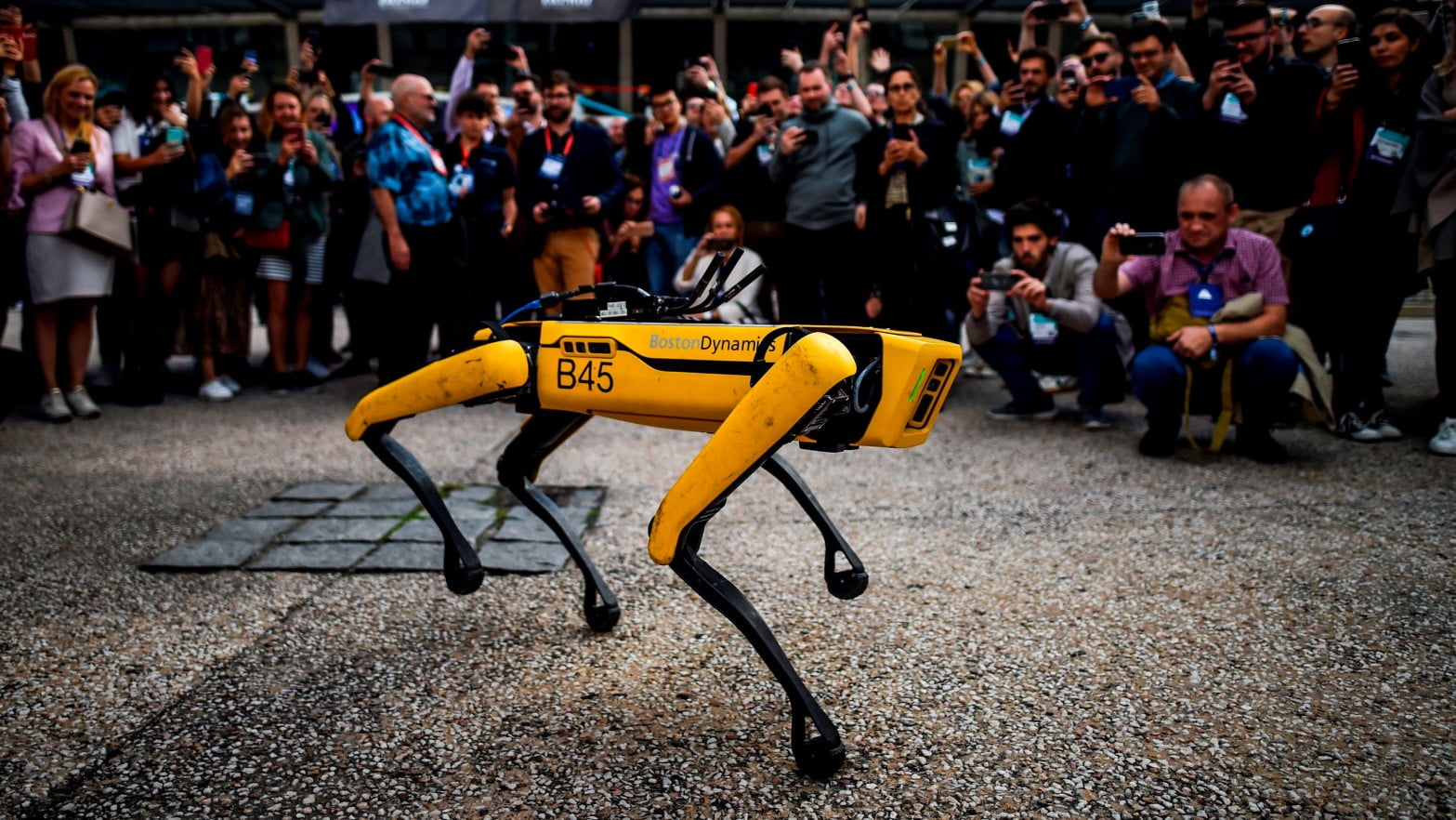
Spot is a compact, nimble four-legged robot that can trot around your office, home, or outdoors. It can map its environment, sense and avoid obstacles, climb stairs, and open doors. It can also fetch you a drink.

Now Businesses interested in buying a Spot—or a pack of them—can go to the company’s website and submit an order form. Spot may cost as much as a luxury car, and it is not really available to consumers. Boston Dynamics wants to find customers in select industries and help them deploy Spots in real-world scenarios.

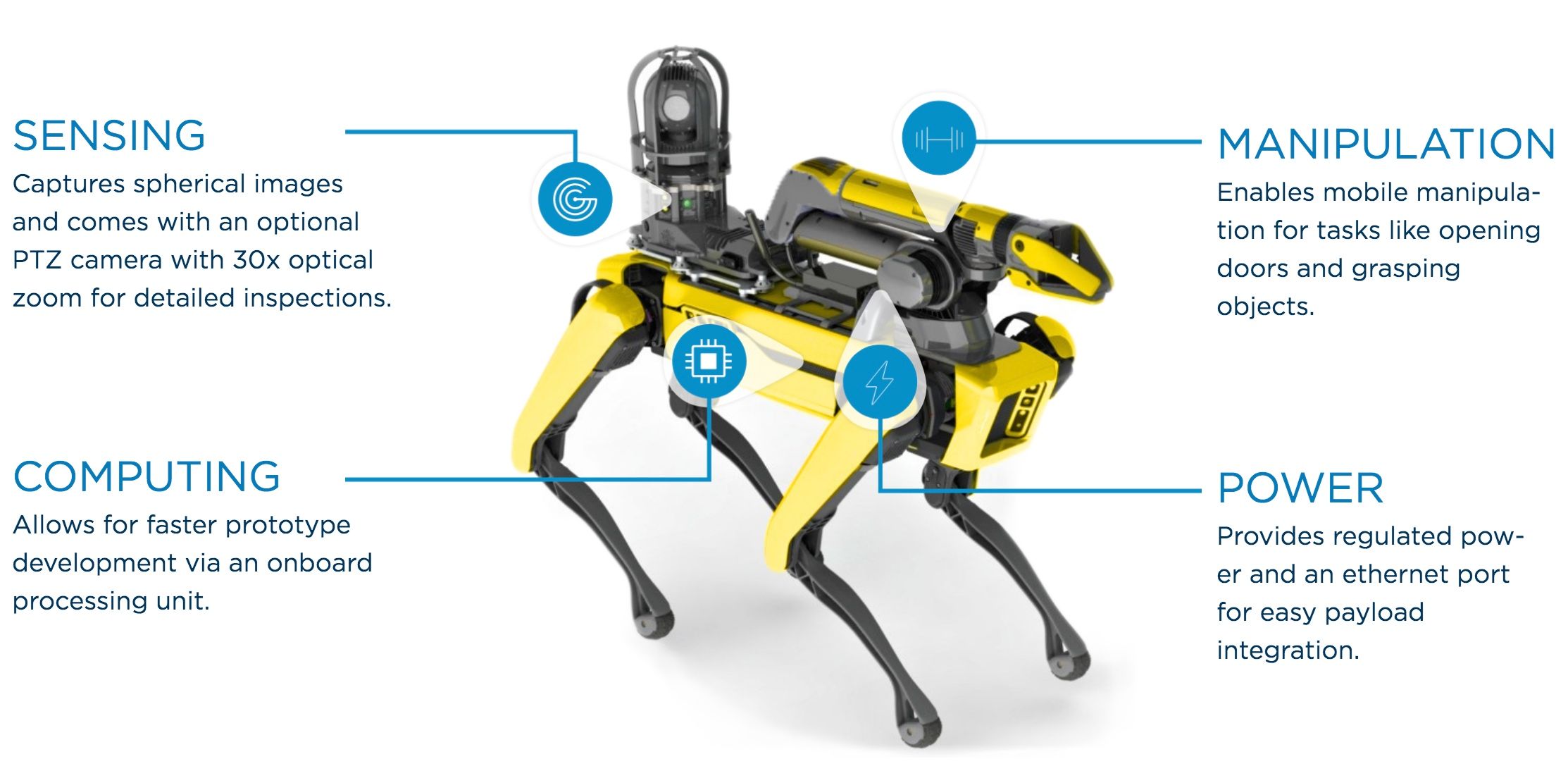
Spot can walk, trot, avoid obstacles, climb stairs, and much more. The robot’s hardware is almost completely custom, with powerful compute boards for control, and five sensor modules located on every side of Spot’s body, allowing it to survey the space around itself from any direction. The legs are powered by 12 custom motors with a reduction, with a top speed of 1.6 meters per second. The robot can operate for 90 minutes on a charge. In addition to the basic configuration, you can integrate up to 14 kilograms of extra hardware to a payload interface. Among the payload packages Boston Dynamics plans to offer are a 6 degrees-of-freedom arm, a version of which can be seen in some of the YouTube videos, and a ring of cameras called SpotCam that could be used to create Street View–type images inside buildings.
Learning to drive the robot using its gaming-style controller “takes 15 seconds,” says CEO Marc Raibert. He explains that while teleoperating Spot, you may not realize that the robot is doing a lot of the work. “You don’t really see what that is like until you’re operating the joystick and you go over a box and you don’t have to do anything,” he says. “You’re practically just thinking about what you want to do and the robot takes care of everything.” The control methods have evolved significantly since the company’s first quadruped robots, machines like BigDog and LS3. “The control in those days was much more monolithic, and now we have what we call a sequential composition controller,” Raibert says, “which lets the system have control of the dynamics in a much broader variety of situations.” That means that every time one of Spot’s feet touches or doesn’t touch the ground, this different state of the body affects the basic physical behavior of the robot, and the controller adjusts accordingly. “Our controller is designed to understand what that state is and have different controls depending upon the case,” he says.

The Spot comes at a cost of nearly $74,000 for huge firms to get and apply in the real world.

Boston Dynamics built an API so that customers can create application-level products with Spot without having to deal with low-level control processes. “Rather than going and building joint-level kinematic access to the robot,” Perry explains, “we created a high-level API and SDK that allows people who are used to Web app development or development of missions for drones to use that same scope, and they’ll be able to build applications for Spot.”

All about Spot, the Robot Dog.

All about Spot, the Robot Dog.


Spot is a compact, nimble four-legged robot that can trot around your office, home, or outdoors. It can map its environment, sense and avoid obstacles, climb stairs, and open doors. It can also fetch you a drink.

Now Businesses interested in buying a Spot—or a pack of them—can go to the company’s website and submit an order form. Spot may cost as much as a luxury car, and it is not really available to consumers. Boston Dynamics wants to find customers in select industries and help them deploy Spots in real-world scenarios.

Spot can walk, trot, avoid obstacles, climb stairs, and much more. The robot’s hardware is almost completely custom, with powerful compute boards for control, and five sensor modules located on every side of Spot’s body, allowing it to survey the space around itself from any direction. The legs are powered by 12 custom motors with a reduction, with a top speed of 1.6 meters per second. The robot can operate for 90 minutes on a charge. In addition to the basic configuration, you can integrate up to 14 kilograms of extra hardware to a payload interface. Among the payload packages Boston Dynamics plans to offer are a 6 degrees-of-freedom arm, a version of which can be seen in some of the YouTube videos, and a ring of cameras called SpotCam that could be used to create Street View–type images inside buildings.

Learning to drive the robot using its gaming-style controller “takes 15 seconds,” says CEO Marc Raibert. He explains that while teleoperating Spot, you may not realize that the robot is doing a lot of the work. “You don’t really see what that is like until you’re operating the joystick and you go over a box and you don’t have to do anything,” he says. “You’re practically just thinking about what you want to do and the robot takes care of everything.” The control methods have evolved significantly since the company’s first quadruped robots, machines like BigDog and LS3. “The control in those days was much more monolithic, and now we have what we call a sequential composition controller,” Raibert says, “which lets the system have control of the dynamics in a much broader variety of situations.” That means that every time one of Spot’s feet touches or doesn’t touch the ground, this different state of the body affects the basic physical behavior of the robot, and the controller adjusts accordingly. “Our controller is designed to understand what that state is and have different controls depending upon the case,” he says.

The Spot comes at a cost of nearly $74,000 for huge firms to get and apply in the real world.

Boston Dynamics built an API so that customers can create application-level products with Spot without having to deal with low-level control processes. “Rather than going and building joint-level kinematic access to the robot,” Perry explains, “we created a high-level API and SDK that allows people who are used to Web app development or development of missions for drones to use that same scope, and they’ll be able to build applications for Spot.”

Enable Optimization for improving page speed on Firefox?

Enabling will throttle your experience throughout the site, you will have reduced animations, no transparency effects, potentially reduced visual harmony. Learn why

You won't be prompted again, but you can change your settings by clicking on the bottom left icon.

We use cookies 🍪 & trackers for analytics & performance. By browsing, you accept our Privacy Policy - Learn more. Exit to opt-out