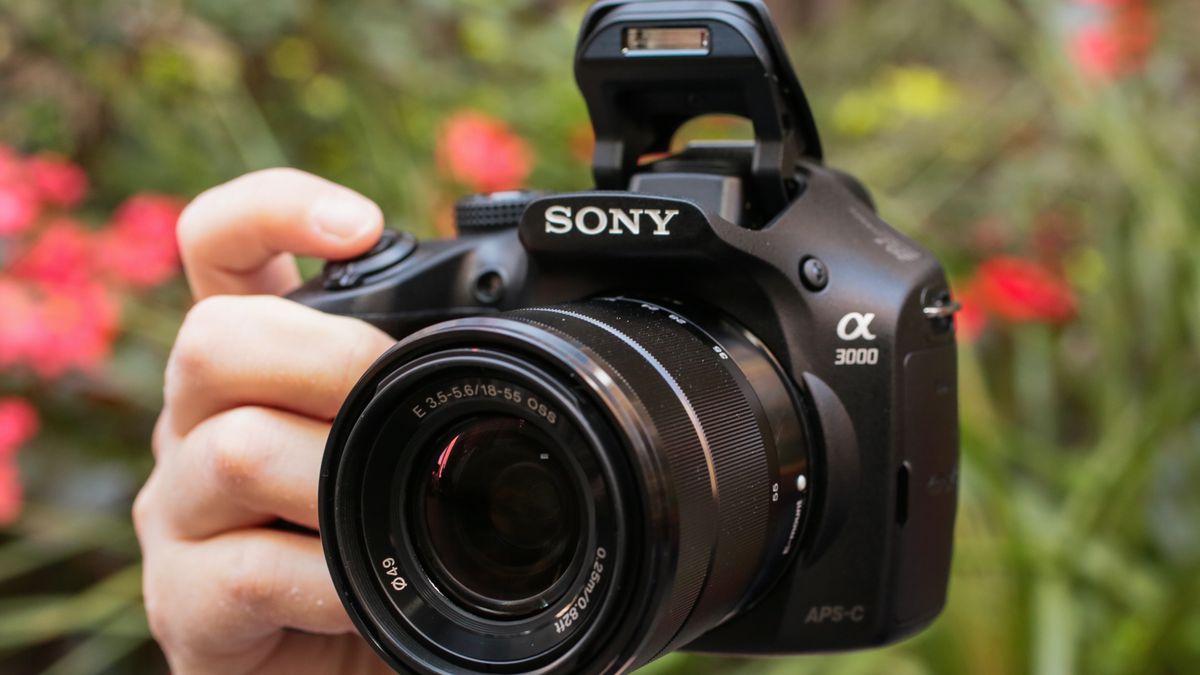

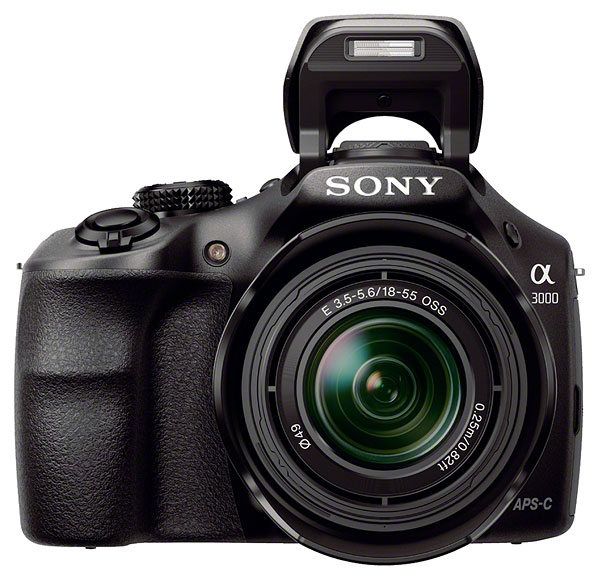
The A3000 uses the same sensor format that Sony builds into its full-sized Alpha DSLR cameras, including the same adaptive noise reduction technology from their flagship A99. The A3000 is compatible with Sony’s growing selection of E-mount lenses; smaller, lighter and designed specifically for Sony’s compact interchangeable lens cameras (NEX). Aimed for beginning users who prefer the look and feel of a traditional DSLR, it provides a built-in electronic viewfinder. At its introduction the A3000 costs less than any other interchangeable lens camera on the market, though the trade-off in low-cost components is evident.
Specsheet
| MSRP | $399 with 18-55mm lens |
|---|---|
| Body type | SLR-style mirrorless |
| Max resolution | 5456 x 3632 |
| Other resolutions | 3872 x 2576, 2736 x 1824 |
| Image ratio w:h | 3:2, 16:9 |
| Effective pixels | 20 megapixels |
| Sensor photo detectors | 20 megapixels |
| Sensor size | APS-C (23.5 x 15.6 mm) |
| Sensor type | CMOS |
| Processor | BIONZ image processor |
| ISO | ISO 100-16000 selectable in 1 EV steps |
| White balance presets | 9 |
| Custom white balance | Yes |
| Image stabilization | Optical |
| Image stabilization notes | Lens-based (where applicable) |
| Uncompressed format | RAW |
| JPEG quality levels | Standard, Fine |
| Autofocus | Contrast Detect (sensor)Multi-areaCenterSelective single-pointTrackingSingleContinuousFace DetectionLive View |
| Manual focus | Yes (Focus Peaking Level setting: High/Mid/Low/Off, Color: White/Red/Yellow) |
| Number of focus points | 25 |
| Lens mount | Sony E |
| Focal length multiplier | 1.5× |
| Articulated LCD | Fixed |
| Screen size | 3″ |
| Screen dots | 230,400 |
| Touch screen | No |
| Screen type | TFT LCD |
| Live view | Yes (Continuous Live View) |
| Viewfinder type | Electronic |
| Viewfinder coverage | 100% |
| Viewfinder magnification | 0.7× (0.47× 35mm equiv.) |
| Aperture priority | Yes |
| Shutter priority | Yes |
| Manual exposure mode | Yes |
| Subject / scene modes | Yes |
| Built-in flash | Yes (Built-in, Pop-up Auto) |
| Flash range | 6.00 m (at ISO200 / 4m at ISO100) |
| External flash | Yes (hot shoe) |
| Flash modes | Flash off, Auto flash, Fill-flash, Slow Sync., Rear Sync. |
| Continuous drive | 2.5 fps |
| Self-timer | Yes (2-sec. or 10-sec. delay) |
| Metering modes | MultiCenter-weightedSpot |
| Exposure compensation | ±3 (at 1/3 EV steps) |
| AE Bracketing | (3 frames at 1/3 EV, 2/3 EV steps) |
| Format | AVCHD, H.264 |
| Microphone | Stereo |
| Speaker | Mono |
| USB | USB 2.0 (480 Mbit/sec) |
| HDMI | Yes (Type C mini)) |
| Remote control | Yes (via optional RM-VPR1) |
| Environmentally sealed | No |
| Battery | Battery Pack |
| Battery description | NP-FW50 |
| Battery Life (CIPA) | 470 |
| Weight (inc. batteries) | 411 g (0.91 lb / 14.50 oz) |
| Dimensions | 128 x 91 x 85 mm (5.04 x 3.58 x 3.35″) |
| GPS | None |
Review
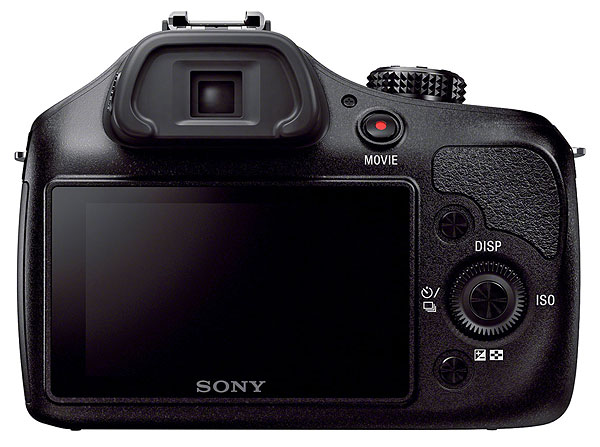
Some cameras are all about cramming in features; the Sony A3000 doesn’t play that game. It’s been pared down to the basics — you get precisely what you need, and little more. But while rivals in its pricetag skimp on the basics with plastic lens mounts and years-old designs, Sony plays its own game, making an affordable camera that you’d actually want to own. But that’s not to say that there are no compromises in the A3000. Read our in-depth Sony A3000 review, and find out whether Sony’s hit the perfect balance between features and cost!
Here’s some Pros
Absolutely incredible value; Includes a stabilized kit lens; More versatile than a fixed-lens bridge camera; Comfortable body with good ergonomics; Great image quality; Good autofocus performance; Decent battery life.
Here’s some Cons
Feels a bit plasticky; Slow burst shooting with limited buffer; Sluggish to power on or switch modes; Low-res EVF and LCD monitor; Can’t review images using EVF; No video output; Weak flash; Battery charges in-camera.

Price and Availability
Available since early September 2013, the Sony Alpha A3000 carries a list price of just US$400 — and that’s with an E 18-55mm F3.5-5.6 OSS stabilized kit lens included in the bundle. For step-up buyers, the lower pricetag means money back in their pocket, or spent on their first system accessories.
Equipped with an Exmor APS HD CMOS image sensor with 20.1 megapixels. Total resolution is 20.4 megapixels, and the APS-C sized chip has a 3:2 aspect ratio. But, the sensor is not stabilized.
Sony doesn’t specify the image processor used in the Alpha A3000 beyond that it’s a BIONZ-branded chip, but as you’d expect in such an affordable, entry-level camera, performance is modest.
Also, Everything from ISO 100 to 16,000 equivalents is available from the Sony A3000. Of this range, ISO 100 to 3200 equivalents is available under automatic control. In movie mode, you’ll face the a reduced upper limit on sensitivity of ISO 3200 equivalent.

As you’d expect in an entry-level camera, the Sony A3000 forgoes a complex hybrid autofocus system, in favor of a simpler, less expensive contrast detection system. The A3000’s CDAF system provides 25 predefined autofocus points, and has a working range of EV 0 to 20 (at ISO 100 with an f/2.8 lens). Center-weighted and flexible spot AF modes are available, as are tracking and AF lock. You can also opt for manual focus, or let the camera get focus in the ballpark and then fine-tune using Direct Manual Focus.
A built-in autofocus illuminator LED has a working range of 0.5 to 3.0 meters with the kit lens attached. Shutter speeds on offer in the Sony A3000 range from 1/4000 to 30 seconds, plus bulb. The A3000 uses an electronically-controlled, vertical traverse focal plane shutter, as well as an electronic first curtain shutter. Exposures are metered using the image sensor, with a 1200-zone evaluative metering system. Metering modes include multi-segment, center-weighted, and spot. 1

The Sony Alpha A3000 can record Full HD (1920 x 1080 pixel; 1080i) movies at a rate of 60 fields per second, although this is derived from 30 frames-per-second sensor data. (In some markets, the 60i rate is replaced with a 50i rate, derived from 25p sensor data.) You can also opt for a film-like rate of 24 progressive-scan frames per second (25p on overseas models), or for lower-res 1440 x 1080 (Anamorphic HD) and 640 x 480 (VGA) movies.
At the maximum resolution, movies are saved using AVCHD version 2.0 (MPEG-4 AVC / H.264) compression with AC-3 stereo Dolby Digital audio. At lower resolutions, movies are saved with MP4 compression and MPEG-4 AAC-LC stereo audio.

As well as its aforementioned Multi Interface Shoe, the Sony A3000 includes a multi-terminal USB port, compatible with the RM-VPR1 wired remote control. It also provides for USB 2.0 High Speed data transfer, but not for video output. In fact, this is one area in which budget has clearly been the overriding factor, because the A3000 also lacks a high-def video output. If you want to get your images on a TV, you’ll need to do it via another device, or on a display with a built-in card reader.
The Sony A3000 draws its power from a proprietary Info Lithium NP-FW50 lithium-ion rechargeable battery pack. Sony rates the camera as good for 460 shots on a charge when using the electronic viewfinder, or 470 shots with the LCD screen, to CIPA testing standards. The battery is charged in-camera via the multi-terminal USB port, and an AC-UB10 USB AC adaptor is included in the bundle. You can also charge the battery via USB from a computer.