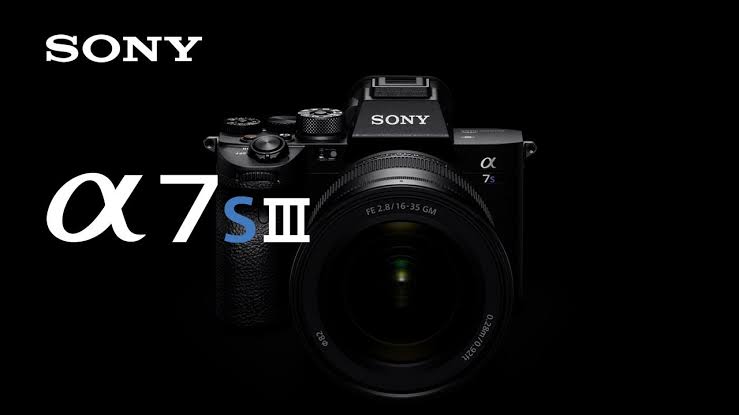

Sony’s alpha 7S Mark III is the third iteration in the most video-focused of the company’s a7 series of full frame cameras. It’s essentially a native 4K camera with impressive video specs and a revised user interface. It can capture UHD 4K footage at up to 120p in 10-bit 4:2:2 encoding and promises 16-bit Raw video output.
- 12MP BSI CMOS sensor
- Bionz XR processor
- On-sensor phase detection
- ISO 80-102,400 (expandable to 40-409,600)
- 9.44M-dot EVF with 0.91x magnification
- 4K video at up to 120p, 60p for ‘at least an hour’
- 16-bit Raw video output at up to 60p
- 10-bit 4:2:2 internal capture (in codecs including H.265 and All-I H.264)
- Fully articulating LCD
- 5-axis in-body stabilization with SteadyShot active mode
- Twin card slots that each accept either SD or CFexpress Type A
- The Sony a7S III sell for around $3500. This is a $500 premium over 2015’s Mark II but still $500 lower than the launch price of the Panasonic Lumix DC-S1H, which we see as its closest competitor.
Sony says it was developed with reliability as a foremost concern. So, rather than trying to shoot 8K or even oversampled 4K, it shoots essentially ‘native’ 4K. This is likely to result in slightly less detailed footage than some of the company’s existing, less video-focused models, but with the benefit of improved rolling shutter and extended record times.
As with the previous a7S models, Sony talks about the camera being a good stills option for low light, but the bulk of the advances in the camera are on the video side of the ledger.
Sensor and processor
While the 12MP resolution hasn’t changed, the a7S III has a different sensor to the one used in its two predecessors. It moves to a BSI design, which Sony says will boost its low light performance (though in the examples we’ve previously seen, it’s a change that makes less and less difference, the larger the pixels are). Interestingly, it features a base ISO of 80, which could bring greater dynamic range.
What’s definitely improved is the sensor readout rate. The a7S III can shoot UHD 4K at up to 60p from its full width (4.2K) or at 120p from a native UHD 4K region (a 1.1x crop).
As well as an updated sensor, the a7S III is the first Alpha camera to feature the new Bionz XR processor. It’s a two-chip processing system that Sony says allows image and video processing to be handled entirely separately from file management and handling, which should reduce latency and allow more complex image processing above and beyond what the claimed 8X increase in processing power brings.
Updated autofocus
Unlike previous ‘S’ models, the a7S III includes on-sensor phase detection elements, allowing more decisive, depth-aware focusing. The camera includes the latest version of Sony’s autofocus system, which can automatically detect faces, eyes and heads, and use the appropriate focus method. This lets you use face detection AF, including in video recording, without the risk of the camera refocusing to a different person if your original subject turns away.
Sony says the new processing improves the performance of the recognition aspect of the AF system.
Not all of the video AF system is quite as sophisticated as in stills: you have to tap to initiate tracking, rather than being able to pre-position an AF point, and there’s no animal eye AF in video mode. But it should be a huge leap forward compared to the contrast-detection of the previous a7S cameras. As you’d expect, video mode lets you specify the speed of AF and how long it waits before switching subjects.
White balance sensor
It’s been a long time since we’ve seen a dedicated external white balance sensor on a camera (Range-topping DSLRs from Canon, Nikon and Olympus used to have them), but they’ve become common on smartphones. And now there’s one on the front of the a7S III.
Combined with the option to control how quickly white balance reacts to changes in the scene (Exposure/Color|White Balance|Shockless WB), it’s aimed at reducing unpredictable white balance shifts as you’re capturing video (if one color suddenly fills the frame, for instance).
Video compression options
Perhaps the most significant improvement for most videographers is the more extensive range of compression options. The a7S III goes far beyond the 8-bit capture of previous a7 cameras. Not only does the camera gain a 10-bit 4:2:2 version of the (H.264-based) XAVC S encoding, it also gains an H.265-based variant called XAVC HS. There’s also an H.264 All-I option called XAVC S-I.
UHD 4K options
Most of the camera’s UHD footage (at least up to 60p) is taken from essentially the full 4240 pixel width of the sensor. This is sufficient that Sony could provide DCI 4K (4096 x 2160) options, but such options are not present.
HEIF stills capture
As well as JPEGs, the a7S III can also capture 10-bit compressed files using the HEIF format. This gives the option of 4:2:0 or 4:2:2 color subsampling. We’d recommend taking the 10% increase in file size to retain more color resolution (4:2:0 is something you usually only encounter in highly compressed JPEGs, in the stills world).
Interestingly, unlike Canon, the Sony doesn’t assume you’re using the move to 10-bit to record lifelike HDR images and will just use whichever color mode you were using for JPEGs. So, while there’s the option to shoot HDRTV-ready images using several variants of the Hybrid Log Gamma tone response (and these will work best in HEIF) you can also shoot 10-bit images with the Standard ‘Creative Look’ or if you wish. Or even S-Log for that matter.
Neither the EVF nor LCD is able to show HDR images but there is a choice of Gamma Assist modes to give you a more usable preview. You need to manually select the appropriate assist mode to match your current shooting mode.
Quad-channel audio
The a7S III has the ability to record up to four channel audio in its video, rather than just two. To do this it needs to be used with the XLR-K3M adapter. This features two XLR inputs and a 3.5mm stereo input (though the left and right channel of the 3.5mm input can’t be adjusted independently).
There’s an option in the Setup menu to select which inputs are output to the two monitoring channels. This includes the option to hear channels 1 and 3 in one ear and 2 and 4 in the other, for full four-channel monitoring.
What we like
- Excellent full-frame 4K footage at up to 60p
- Only slight crop to 4K/120 mode
- Excellent oversampled 1080 footage
- 10-bit capture in H.265, H.264 or All-I H.264 gives workflow and grading flexibility
- Log, HLG or Raw output options
- Solid battery life
- Choice of memory card format with most video recordable to SD or CFe
- Nice viewfinder
- Much-improved user interface
- Option for HLG HDR photos using 10-bit HEIF format
- Image stabilization, usable AF and good battery provides run-and-gun capabilities
- Comfortable ergonomics
- Full-sized HDMI socket
What we Don’t
- No out-of-camera DCI footage
- Missing tools such as waveform display or shutter angle control
- Video AF not quite effective as stills system and requires the screen to be tapped
- 12MP stills appear low res, even at reduced sizes, compared with most modern cameras
- Rear LCD isn’t especially detailed
In spec terms, it’s obviously very impressive that such a small camera can reliably shoot 4K at 24, 30, 60 or 120p, without the need for a significant crop or loss of image quality. Those higher frame rates aren’t likely to be the core way of shooting, but the option to shoot 4K for 1/4 or 1/5 speed slow-mo is impressive. The perfectly oversampled 1080 is excellent, too. For most users, it’s the the ability to shoot all these modes in 10-bit and most of them in 4:2:2 with a choice of All-I or H.265 LongGOP that will be most useful: footage that’s very flexible, both from a grading perspective and in terms of workflow.These higher-end capabilities raise our expectations for the camera. In particular it’s disappointing not to see waveforms on a camera that’s likely to be used as a standalone device. Similarly, if part of the a7S III’s appeal is its ability to switch between different frame rates almost seamlessly, why is there no option to view exposure in terms of shutter angle so that you don’t have to change shutter speed between modes?