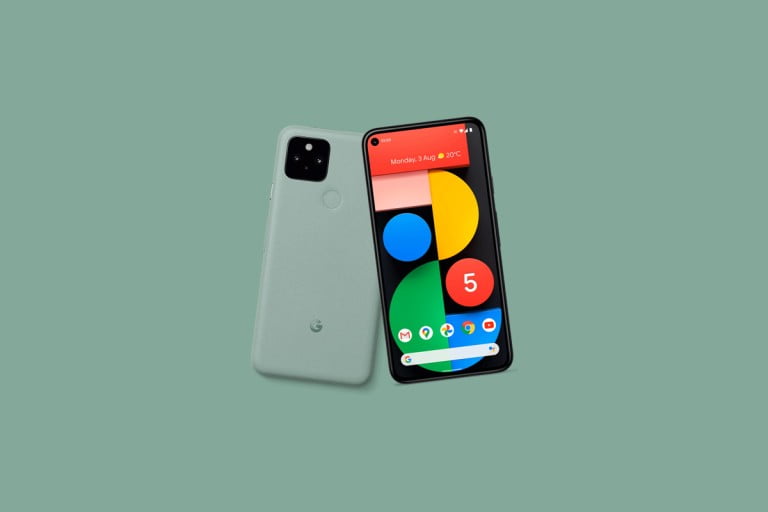

The Google Pixel 5 is the brand new phone from their Pixel series. It is a pinnacle of the simplistic and minimalistic approach and design of the Pixel 5 and Google as a firm.
The Pixel 5 was announced on September 30, 2020, at Google’s Launch Night In event. This is Google’s top-end phone of 2020 and it’s a great option if you want:
- A more affordable 5G phone with some flagship-level features
- A great camera experience
- A smaller-than-typical size
- Quality software and guaranteed updates
The Pixel 5 costs $699 in the US, where it’s available in only one size, two colors, and one storage configuration. It competes with the LG Velvet, the OnePlus 8, OnePlus Nord (outside the US), the Samsung Galaxy A71, the Galaxy S20 FE, and a slew of other upper mid-range to flagship 5G phones.
You should avoid the Pixel 5 if you want:
- The best performance possible in a phone
- Two-day battery life with normal use
- The best zoom capabilities
The $699 Google Pixel 5 looks like a good phone on paper in North America, with brands like Realme and Xiaomi not a factor on the continent. But it still seems like a good purchase in general if you want a 5G phone with brisk updates and flagship-style features but don’t want to pay 2020 flagship money.
In the case of the spec sheet, the Pixel 4 was arguably the least impressive flagship of 2019, packing a small battery and lacking a triple rear camera setup seen on rival phones. For the Pixel 5, it looks like Google has beefed things up in some ways, but not in others.
Google’s phone shares the same price as the Samsung Galaxy S20 FE, and it delivers a few more extras on paper. Things like a 120Hz OLED screen, flagship silicon, triple rear camera, and microSD expansion are all present on Samsung’s phone, making for an arguably more impressive, flexible package.
There are a lot of things to love, These include a fantastic display, great battery life, wireless charging, and IP68 rating, among many others. Then there’s Pixel UI, which is a joy to use.
And let’s not forget about the camera setup. It’s great in all lighting conditions and has a few new features up its sleeve. However, it’s not quite as ahead of the competition as it used to be. Still, most people will be more than happy with the images it can capture.
The phone also has a few drawbacks that you should be aware of. Charging is a bit slow compared to some of the competition. There’s also no telephoto lens on board, which makes the camera setup a bit less versatile than we’d like. Then there’s the processor, which isn’t as powerful as the one you get with last year’s Pixel phones or 2020 flagships, which may or may not be a deal-breaker for you.
Regardless of its issues, the Pixel 5 is a great phone overall, as it does the basics better than any other smartphone on the market.
Specsheet.
| Display | 6-inch OLED 2,340 x 1,080 resolution 432ppi 90Hz refresh rate 19.5:9 aspect ratio >1,000,000:1 contrast ratio |
| Processor | Qualcomm Snapdragon 765G 2x Cortex-A76 6x Cortex-A55 Titan M Security Module |
| GPU | Adreno 620 |
| RAM | 8GB LPDDR4x |
| Storage | 128GB No microSD slot |
| Cameras | Rear Main: 12.2MP, f/1.7 aperture, 1.4µm pixels, optical + electronic image stabilization Secondary: 16MP, f/2.2 aperture, 1 micron pixel, ultra-wide (107-degree FoV) 4K at 60fps/30fps |
| Headphone Jack | No |
| Battery | 4,080mAh 18W charging 12W wireless charging Reverse wireless charging |
| Water Resistance | IP68 |
| Sensor | Proximity / ambient light sensor Accelerometer Gyrometer Magnetometer Pixel Imprint fingerprint sensor Barometer Spectral and flicker sensor |
| Operating System | Android 11 |
| Dimensions and Weight | 144.7 x 70.4 x 8mm 151g |
| Colours | Just Black, Sorta Sage |
The Pixel 5 adopts the same 12MP IMX363 main camera we’ve seen on several generations of Pixels now, including the Pixel 3a and Pixel 4a. The secondary camera is a completely different story though, as Google has eschewed the Pixel 4 line’s 16MP telephoto camera in favour of a 16MP ultra-wide shooter. This new camera means you can capture many scenes without having to take a few steps back, such as cityscapes, landscapes, and groups of people. So what kind of results should you expect from the cameras, then?
the Pixel 5 is still one of the best camera phones you can get, as it takes great images in just about any lighting condition. However, the competition is catching up. David thinks that almost everyone will like the photos captured by the Pixel 5, but a bigger sensor would have maintained its reputation as the king of smartphone cameras.
Software is what makes the cameras on Pixel phone shine, and with the Pixel 5, you’re getting a few new features. The first one is portrait light, which emulates a floating light source that you can shift around the scene and vary in intensity to add or reduce contrast to a subject’s face or clothes. It works really well and produces natural results.
Then there’s Cinematic Pan that uses slow-motion video and software cropping to produce some incredibly smooth pans, an enhanced portrait mode that now works in conjunction with Night Sight, and more.
Google’s new phone features a 4,080mAh battery, which is still smaller than many rival devices, but definitely the biggest we’ve seen in a Pixel. For comparison, the Pixel 4 had a 2,800mAh battery and used a more power-hungry processor — the Qualcomm Snapdragon 855.
With eight hours of screen-on time with the Pixel 5, taking the phone off charge at 8:30AM and having it conk out at 11PM the next day. Heavier usage involving 4K video recording and mobile data usage resulted in closer to six hours of screen-on time, with the phone going off the charger at 7:30AM and still having 10% juice left just after midnight.
Google is also introducing extreme battery saver mode on the Pixel 5. This allows you to decide which apps you’d like to keep on while everything else is paused. Google says this will get you up to 48 hours of extra battery life.
The phone supports 18W charging, which gets the job done but is much slower than a lot of its competitors. Even mid-range devices can hit 30W of charging these days, while other handsets like the Oppo Find X2 Pro or OnePlus 8T support as much as 65W charging. The Pixel 5 also supports wireless charging at 12W and reverse charging at 5W.
One thing that’s a certainty is that the Pixel 5 is weaker than the Pixel 4 and other 2019 flagships (let alone 2020 flagships) when it comes to sheer CPU and graphical power. Our own Robert Triggs compared the Snapdragon 765G to 2020 and 2019 flagship silicon, and the results tell us a lot.
The CPU performance gap is pretty small between the Snapdragon 765G and the Snapdragon 855 when it comes to single-core performance. But the Snapdragon 855 streaks ahead when it comes to multi-core results, owing to it offering more heavyweight CPU cores. We also see a pretty big gap when it comes to graphical performance.
In other words, those wanting to play the most advanced games and emulators at a smooth framerate might want to buy a Snapdragon 865 or Snapdragon 855 phone. But the Pixel 5’s chipset should still deliver great performance in general and in most games. In fact, as noted in his review, David didn’t notice any lag or slowdown with general usage.
The Pixel 5 lacks two main features compared to the Pixel 4, and that’s the flagship silicon and Motion Sense/face unlock technology. We’ve already covered the chipset disparity, but the lack of Motion Sense and associated face unlock tech is pretty notable.
Motion Sense gestures weren’t to everyone’s liking, while face unlock has become less important than ever thanks to COVID-19. However, Google has resurrected the rear fingerprint scanner, allowing you to unlock your phone while still wearing a mask. Furthermore, fingerprint unlock is supported by a ton of apps (unlike face unlock).
Otherwise, the Pixel 5 also sees RAM and base storage upgrades. Instead of the Pixel 4’s 6GB of RAM and 64GB of base storage (with an option for 128GB), you’ve got 8GB of RAM and 128GB as the sole option.
Moving to photography, Google has ditched the Pixel 4 family’s 16MP telephoto secondary camera in favor of a 16MP ultra-wide secondary shooter. It’s disappointing that Google didn’t offer a flexible triple rear camera setup, as we’ve seen from rival manufacturers. Nevertheless, we’re glad to see an ultra-wide rear camera on a Pixel, and Super Res Zoom should still deliver decent results at short-range zoom factors.
We also see a battery capacity bump compared to the Pixel 4 series, leaping to 4,080mAh. Meanwhile, the Pixel 4 packs a 2,800mAh cell, while the Pixel 4 XL offers a 3,700mAh battery.
The screen size falls in between the Pixel 4’s 5.8-inch panel and the XL’s 6.3-inch screen, coming in at 6-inches (19.5:9, 2,340 x 1,080). Much like the Pixel 4a, though, the Pixel 5 packs a more modern punch-hole cutout instead of a bezel or notch.
The Google Pixel 5
The Google Pixel 5 is available from the Google Store, Amazon, and other retailers. It costs $699. You can get yours via the links below. Get Yours!